 Peter Founder
Obsidian + Claudian: A Karpathy-Style Media Buying Knowledge Base
Today let’s talk about AI knowledge bases, which have been all the rage lately. After using Obsidian + Claudian in depth, I built myself a personal media buying knowledge base.
The pain point: which GEO is running well right now, which network’s offers are reliable, why that offer died last time, what the best bid range is for social traffic, how exactly to tune a Facebook Bid Cap… All of that experience is scattered across chat logs, forum bookmarks, screenshots from the tracker back end, and the gut calls that flash through your own head.
The problem is, your brain forgets. Bookmarks sink to the bottom. You give up after scrolling three pages of chat history.
Over the past two weeks I did one thing: I used Claude Code + Obsidian to build myself an affiliate-only “second brain”. Not the kind of note vault you set up on a whim (I’ve built several of those before, and they all died), but a knowledge base the AI maintains for me — I throw material in, it organizes, categorizes and cross-links it, and when I need it, it can directly answer “what do I understand about this material”.
So far, the system has helped me build up dozens of structured distilled notes covering 10 categories, including Email Marketing, Native ads, Facebook media buying and Survey Lists. Each one is playbook-level material extracted from my own past notes, experience and popular forum threads.
Here’s a quick rundown of how I did it and a few takeaways.

Why the traditional approach doesn’t work
Knowledge in the affiliate world has a few characteristics:
Fragmented. One key piece of information might be buried in reply #200 of a Discord thread, in a voice message from an AM, or on page 180 of a 300-page thread on a paid forum.
Time-sensitive. A GEO that ran well last year may be dead this year; an offer that still worked last month may have been pulled this month.
Hard to reuse. The bidding experience you built up running Facebook may not carry over at all to a different traffic source. The optimization thinking is universal — the problem is that the universal part is hard to abstract out of specific campaign data.
What do most people do? Bookmarks. Save and almost never read; read and never organize; organize and still can’t find it next time.
The current mainstream approach
The core idea comes from Andrej Karpathy (former Director of AI at Tesla, founding member of OpenAI). This year he shared a concept: have an LLM maintain a persistent wiki for you instead of searching from scratch every time.
His own practice: using an LLM, he accumulated a wiki of more than 100 articles and 400,000 words on one research topic — he didn’t write a single word himself, but he can run complex queries against that wiki any time. Essentially the knowledge is “precompiled”, instead of being dug out of the raw material again every time you ask a question.
I moved that idea over to affiliate marketing. The implementation is Obsidian (local Markdown notes) + Claude Code (the AI processing layer). The whole system has three layers:
Source layer (immutable): my own core notes, Discord / forums, Feishu (Lark) documents — the raw content is stored here untouched, as the foundation.
Knowledge layer (AI-maintained): the AI “distills” structured methodology out of the source material.
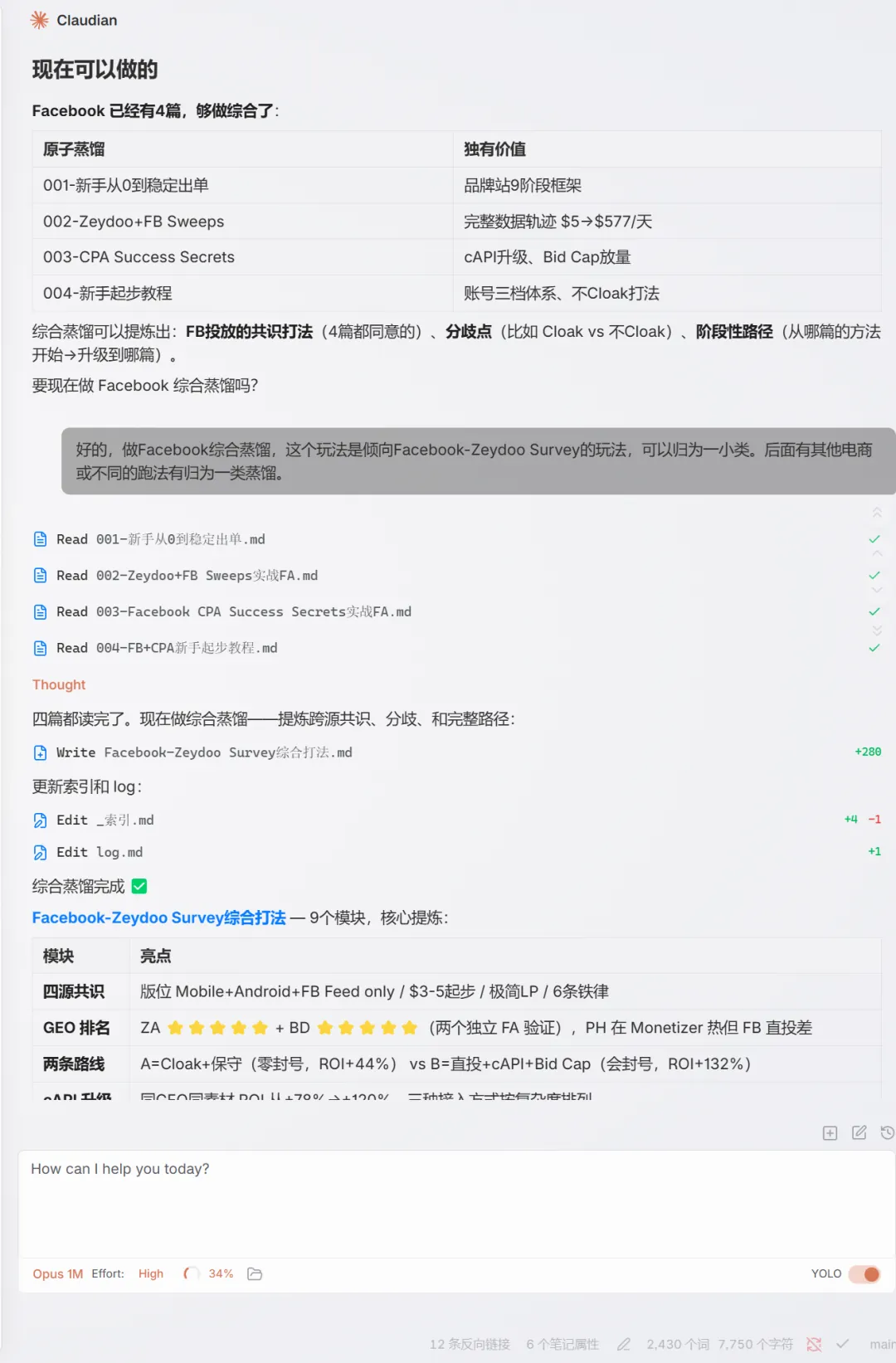
For example, a TikTok Journey thread with 535 posts gets distilled into 10 modules — tracking architecture, campaign optimization, email strategy, offer testing methodology, lessons from failures — each with concrete data and operating rules.
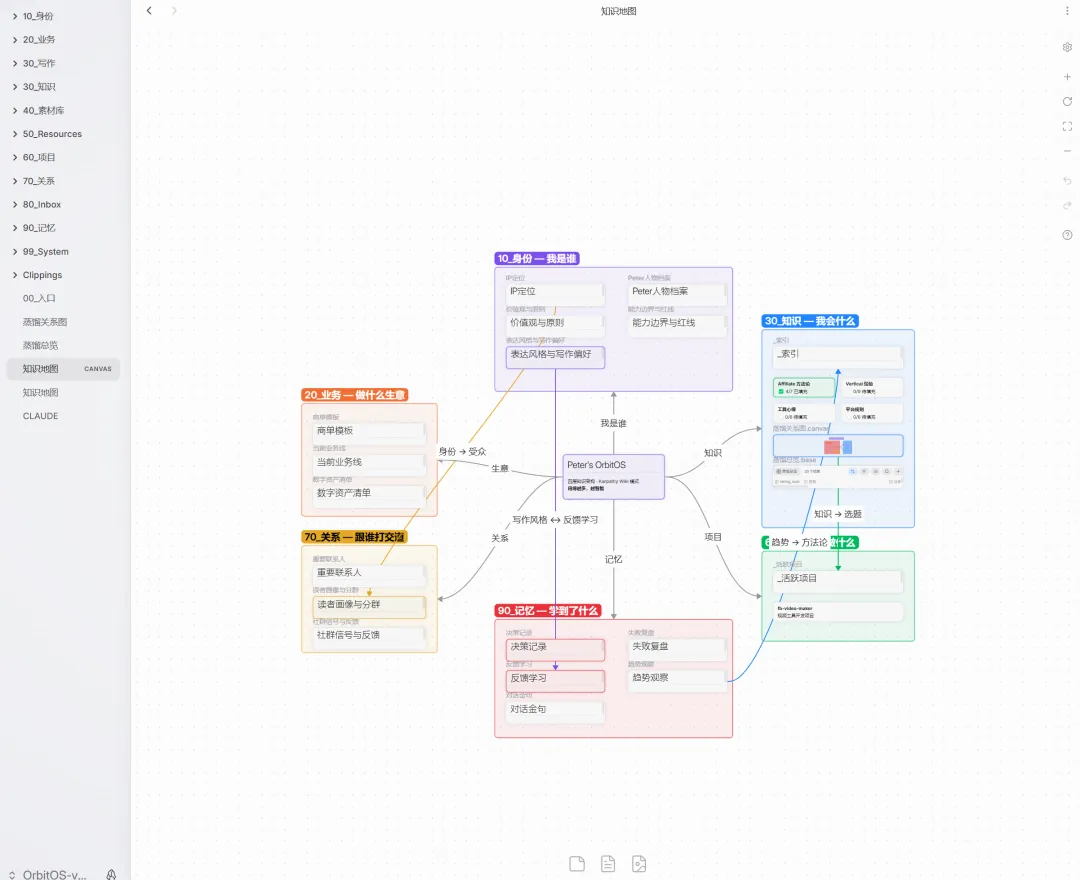
Memory layer (personal): my decision log, post-mortems on failures, trend calls. This layer is purely personal — the AI maintains it for me, but the content is entirely my own judgment.
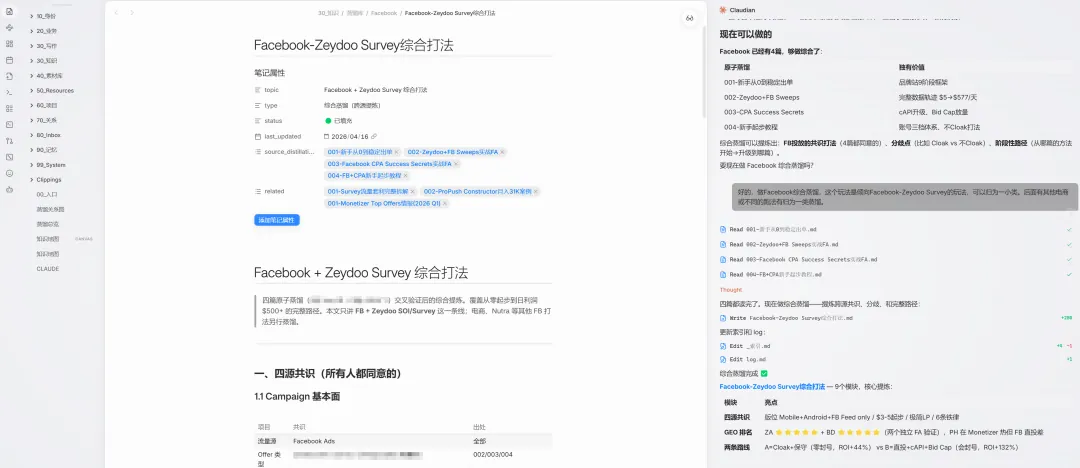
The key point: I don’t write the knowledge base, the AI does. I only throw material in and tell it “distill this”; it automatically figures out where it should go, which existing knowledge it links to, and whether it contradicts an older judgment.
A few impressions after two weeks
1. The value of a knowledge base isn’t how much it stores, it’s how much gets used
With the note vaults I built before, once something was saved that was the end of it; next time I needed it I’d still Google.
Now it’s different — I ask the AI how much I know about Native ads, and it pulls Owna’s AdsKeeper playbook and Susie’s MGID plan straight out of the knowledge base, and tells me where the two platforms differ.
That precompiled feeling is completely different from searching from scratch every time.
2. Cross-domain links are the most valuable part
After I distilled the Push + Email thread, the system automatically linked it to another note on Email Marketing. One is an email strategy for promoting Finance offers, the other is building an email list in the Beauty vertical — they look totally unrelated, but the AWeber deliverability pitfalls, the best practices on send frequency and the list-cleaning methodology are completely universal.
That kind of cross-vertical knowledge reuse is something bookmarks can’t do.
3. AI maintenance ≠ AI fabrication
This is the point I care about most.
The problem with AI isn’t that it’s not smart enough, it’s that it’s too smart — it will make up content that looks plausible but has no actual basis.
My approach is to tag every judgment: is this a fact extracted directly from the original thread? Something the AI inferred by synthesis? Or a case where multiple sources contradict each other and I have to rule on it myself?
For a knowledge base to be useful, it first has to be trustworthy.
Who this is for
Honestly, this setup isn’t for everyone.
If you’ve just entered the industry and are still feeling your way to your first profitable campaign, your energy should go into media buying, not into building a knowledge base.
But if you’ve been running campaigns for a while, have plenty of experience in your head that you only got by running, and often feel like “I’ve seen this before but can’t remember” — then building an AI-maintained knowledge base might be the most worthwhile thing you do this year.
Not because it makes you money directly, but because it stops your experience from getting lost.
Every campaign you’ve run, every pitfall you’ve hit, every forum thread you’ve read becomes a basis for decisions you can call up at any time.
That’s what a knowledge base does — it’s just that before, you relied on your brain to remember, and now you hand it to the AI to remember for you.
New articles and quick notes from Peter.