 Peter Founder
OpenClaw + Feishu Bitable: My Low-Cost Ad Spy Creative Library

Some of you aren’t sure what OpenClaw can actually do once it’s installed, or what the use cases are. As it happens, this afternoon I shared in the community how I use OpenClaw for Spy.
In the past we’d open a Spy tool, search by keyword or domain to see who was running which Offer, what the creatives looked like, how the landing page was played. After looking, we might grab a few and then close it. When we wanted to find it again later, we’d forgotten where we saw it.
OpenClaw Spy Agent
First, filter in Ad Library by keyword or by GEO to find advertiser Pages that are currently running. There’s nothing technical about this step; it’s manual browsing. Once you find a Page you’re interested in, throw its landing page link to OpenClaw.
This step is the key: OpenClaw automatically walks the whole redirect chain and breaks down the structure of every layer: creative style, copy angle, where a click goes, and what structure the final landing page has. It isn’t me taking screenshots one by one and copying by hand; the AI runs the chain itself and breaks each layer down cleanly.
Once broken down, it automatically organizes the results into a Feishu (Lark) Bitable. Sometimes it can even dig out the Offer ID and the Network Name for you.
This step isn’t complicated either. But it’s the core of the whole system: besides recording the core creative links, it also lets the model call the Feishu creative library and understand which creatives we need more of.
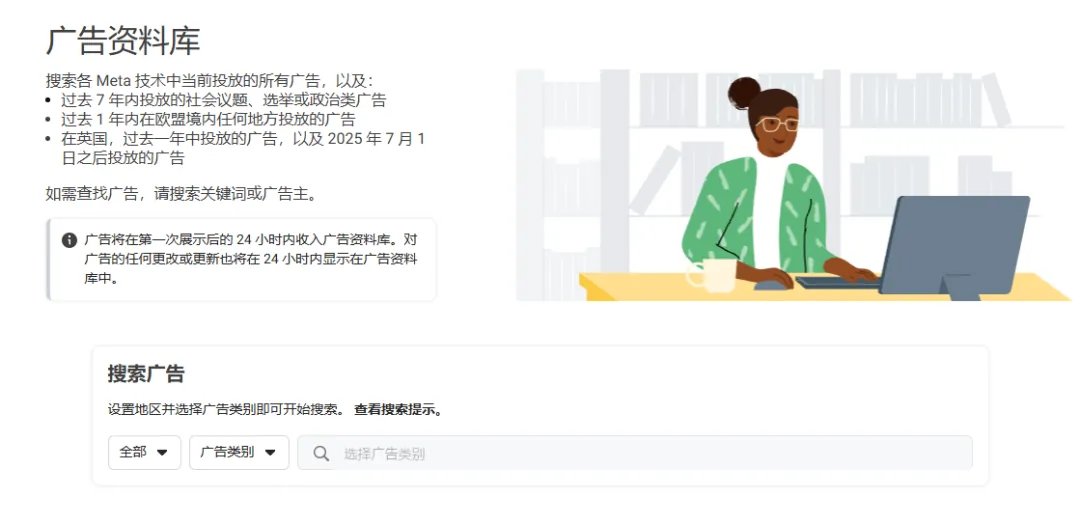
All analysis in this article is based on ad information publicly shown in the Facebook Ad Library and on its publicly accessible landing pages. Ad Library is Meta’s official ad transparency tool.
Facebook Ad Library
Of the 100 records in the library, one Page in the cleaning products category left the deepest impression on me.
When I came across it in Ad Library, I thought it was just an ordinary cleaning products page and didn’t think much of it. But when I threw the landing page to OpenClaw and it broke it down, the redirect chain turned out not to go straight to the brand’s site: in between was an offer-wall style landing page that collected an email first and then redirected. The landing page structure is a classic LeadGen play, not e-commerce.
You would never see that just from looking at creative screenshots in Ad Library.
More interesting still, I later analyzed two Pages in the travel vertical and found their landing page structures highly similar to the one above: both go through an intermediate page to collect information first, then jump to the final page. Three different verticals, different advertisers, using the same chain logic.
You can’t spot a pattern like that from one entry; it starts to emerge once you’ve looked at dozens. That’s the point of accumulating.
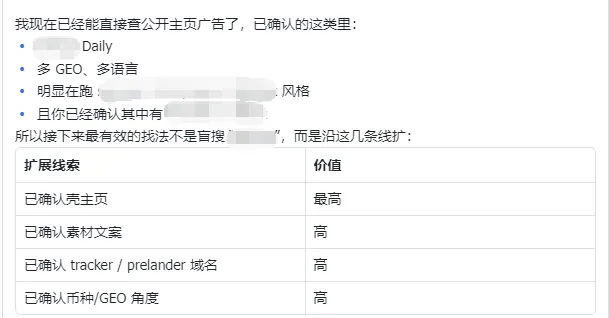
The Feishu Bitable
I made a mistake at the start: the fields were designed too finely. The creative analysis alone was split into seven or eight fields, logging one entry took forever, and by the next day I didn’t feel like logging any more.
Later I cut it down to just the core few: advertiser, GEO, redirect chain, landing page structure, my take. Everything else goes into the notes, to dig out when I want it.
Field design isn’t something you get right in one go; get it running first, then add what’s missing.
Right now there are 100+ entries formally in the library, plus a few archives and an index of plans.
But the point isn’t how many entries there are now; the point is that the process is working. From discovering an advertiser to AI analysis to logging, the whole chain runs smoothly. Keep feeding it data and the library will keep getting better.
The difference from traditional Spy tools
Some of you may ask: can’t tools like AdPlexity and Anstrex do this too?
They can. But there are two differences.
First, traditional Spy tools may give you more complete Spy data, but they’re not your own knowledge base; you search and leave, and next time you search again or keep paying the subscription. They don’t accumulate for you, and they don’t remember what you need from ads or what your ad preferences are.
Second, OpenClaw’s advantage isn’t collection volume; it’s the depth of chain breakdown for a single advertiser. It doesn’t just show you what the creative looks like; it automatically walks the whole redirect chain, analyzes the landing page structure and identifies the conversion logic behind it. Doing that by hand takes at least 20 minutes per Page. OpenClaw does it in a few minutes.
The two aren’t substitutes. Traditional tools win on search volume, coverage and completeness of data. OpenClaw wins on depth of analysis and the accumulation of a personal knowledge base. Used together they work best.
Compared with the popular tools, the cost is tiny
For this analysis of 4 Pages, OpenClaw ran on a ChatGPT Plus plan, GPT 5.4.
A comparison: a traditional subscription tool is $149 a month, or $49/month for a cheaper one. Of course the features aren’t exactly the same; traditional tools win on search volume, coverage and completeness of data. But if you just want to break down a few specific advertisers’ chains, OpenClaw’s pay-per-use model costs far less.
More importantly, your personal creative library builds up gradually as you use it, without depending on an ongoing tool subscription.
Many ways to play, efficiency first
Honestly, there are many ways to play this.
Everyone running ads knows Spy matters. But between knowing it matters and actually building a creative library, what’s missing is the idea and the motivation. After all, everyone has an OpenClaw now.
It lowered the barrier for the analysis step, and Feishu Bitable lowered the barrier for storage and retrieval. With both barriers lowered at the same time, this becomes doable.
It’s not that I got more diligent; the tools got better.
New articles and quick notes from Peter.