 Peter Founder
OpenClaw $100 Ad Test Update: It Made Money, More Than Expected

After I published the post about giving OpenClaw $100 to run ads, two kinds of reactions came in.
The first: anticipation, and wondering just how big an effect AI can really bring.
The second: nobody is going to hand it the permissions to run ads, it’s a pure gimmick.
Over the better part of a month, quite a few people have messaged me privately: they’ve started running ads with OpenClaw too, and in all sorts of ways. Facebook, Native… it really opened my eyes. Looks like most people have jumped into the pool as well; trying new toys is always fun.
Today I’m handing in the follow-up to that OpenClaw ad test. Straight to the Zone Watchdog Pro data from February 8:
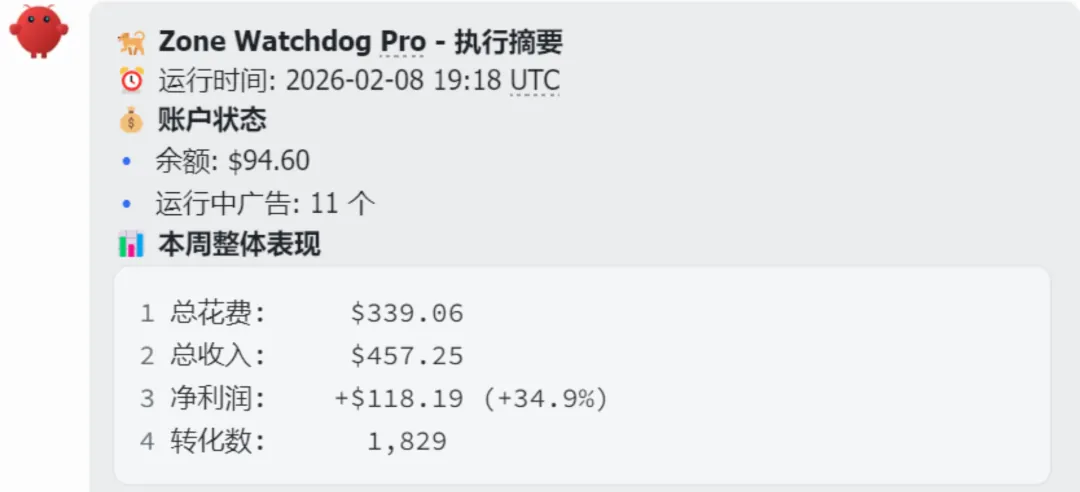
The initial $100 went in, then I topped up the budget. In total it spent $339 and brought back $457.
A few lessons from this experiment:
First: with the offer GEOs picked right, AI amplified my judgment
This time I didn’t let the AI freewheel. I used my own experience to frame the priority GEOs first, then let it optimize execution within that range. The steering wheel stayed in my hands; the gas and the brake went to the AI.
A lot of people’s first question is whether it can be fully automatic. My answer: it can, but I don’t recommend it. Keep the high-value decisions with a human and hand the high-frequency repetitive actions to the AI. Your win rate is higher that way.
Second: permissions aren’t give or don’t give, they’re how you give them
“Nobody will hand it the permissions to run ads” is only half right. The mature approach isn’t handing over power with nothing on, it’s layered authorization:
Read permissions open by default: view data, produce reports;
Low-risk write permissions opened under control: bid changes, pauses;
High-risk actions need a second confirmation: large budget changes, bulk operations.
Designed this way, the AI isn’t an uncontrollable black box; it’s an execution system with boundaries and an audit trail. So the question was never whether you dare give it permissions, but whether you’ve designed the permissions into a structure you can manage.
Third: media buying doesn’t run on a magic prompt, it runs on a closed loop of rules
The reason this round ran a positive ROI wasn’t some particular prompt. It was three things forming a closed loop:
Monitoring: continuously watching spend, conversions and ROI swings;
Stop-loss: act the moment a threshold is hit, no hesitation;
Optimization: add budget to what has potential, whitelist it quickly, and deal with the laggards fast.
These three steps sound ordinary, but plenty of beginners know exactly what to do and just can’t execute it consistently. The AI’s biggest value is turning “got it right occasionally” into “got it right every day”.
Fourth: from daily reports to decision collaboration
A lot of automation used to just send a pile of numbers, and after reading them a human still had to make the call. This time I changed the output into an actionable summary: whether manual intervention is needed right now, which ads keep running and which have already been auto-stopped, and the recommended actions for the next cycle.
It no longer just tells you what happened; it tells you what it has just done and what you should get ready for. Going from an information-push tool to a decision-collaboration tool, the difference in experience is huge.
Finally, a suggestion for those who want to test it themselves: don’t chase replacing a human right away, chase freeing up your hands first. Use $100 to validate the process, $200 to validate stability, and only then think about scaling.
After this live run, I’m more certain of one thing: the AI’s value in media buying isn’t performing intelligence, it’s taking the scattered judgments in your head and solidifying them into execution that can run every day.
Once execution is stable, profit is the result, no longer just luck.

Income and ROI figures here are past results of one person or case, not typical outcomes. Paid traffic can lose money; start with a small test budget.
New articles and quick notes from Peter.