 Peter Founder
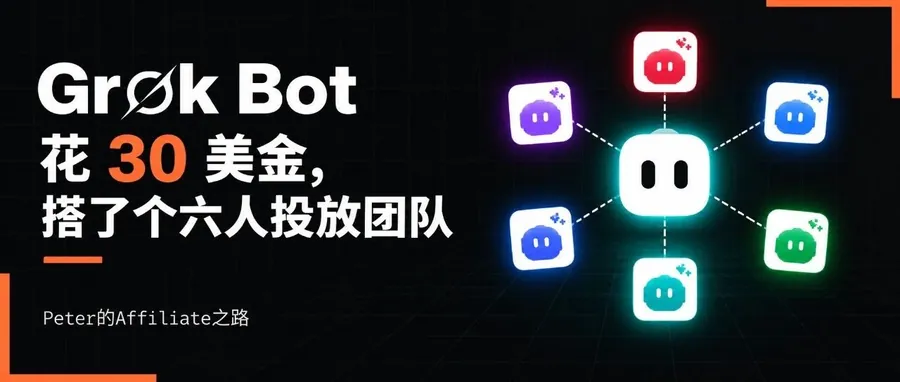
I Built a Six-Person Media Buying Team for $30
Grok Bot
Hi, I’m Peter.
For the past few days I’ve been playing with Grok Bot, which xAI released in August. It’s pretty interesting.
In short, it gives the AI a computer of its own: a cloud VM that’s online 24 hours a day. It can open a browser, log into dashboards and click buttons like a person.
It responds fast, and burns tokens fast too. I used it to set up a six-person media buying team; here’s the process and how it felt.
01 What Grok Bot is
The beta went live on August 11. This was xAI’s announcement at the time:
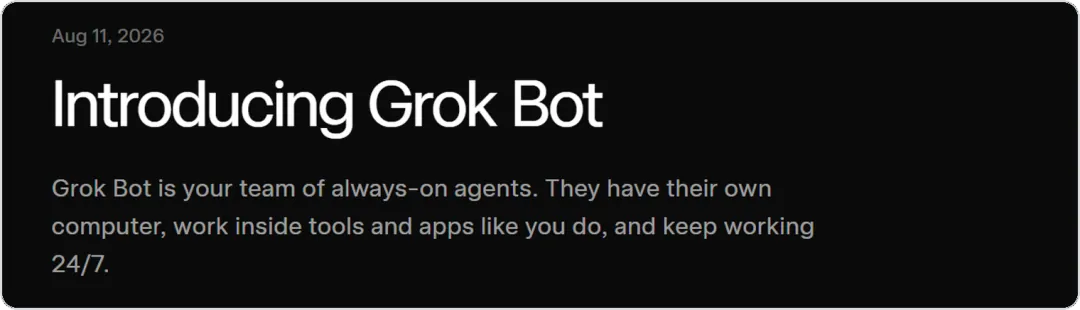
The Grok Bot announcement
It comes down to three things.
Its own computer: a cloud VM with a browser, a file system and a terminal. All your bots share this one machine, and it keeps running after you shut your own computer down.
Straight from the onboarding page:
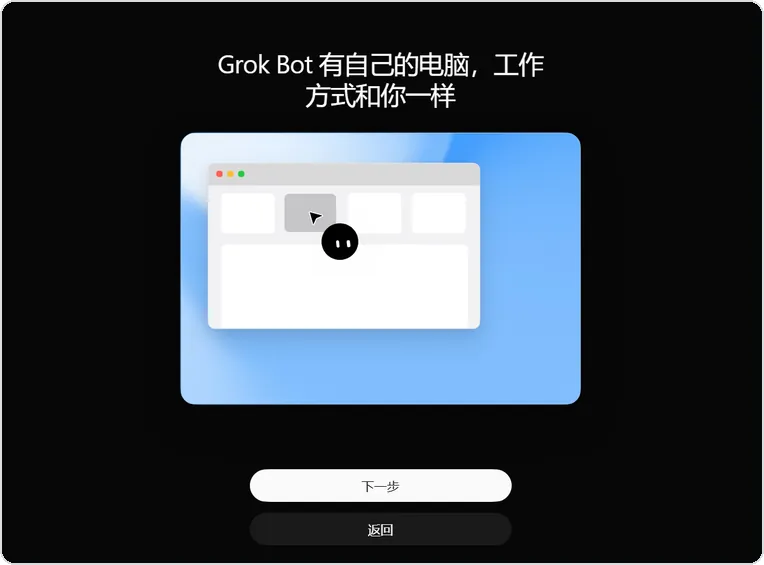
Grok Bot has its own computer
Uses software like a person: it logs in, clicks and pages through things right in the browser. Any dashboard without an API, it can still get into.
Show it once and it learns: you do something once, it records it and saves it as a Routine, then runs it by itself on a schedule or on an event. Screen-recorded teaching is capped at 10 minutes.
Assigning work is just chatting. It reports back when it’s done, and only comes to ask you when something needs your call.
One account can run roughly 50 bots, a group chat holds at most 6, and bots can hand work to each other.
On August 29 it got connected to X: it can search posts, check mentions and manage bookmarks. People who make content will care more about that.
On pricing: since August 26, Grok Bot has been bundled into every paid SuperGrok and Cursor tier:
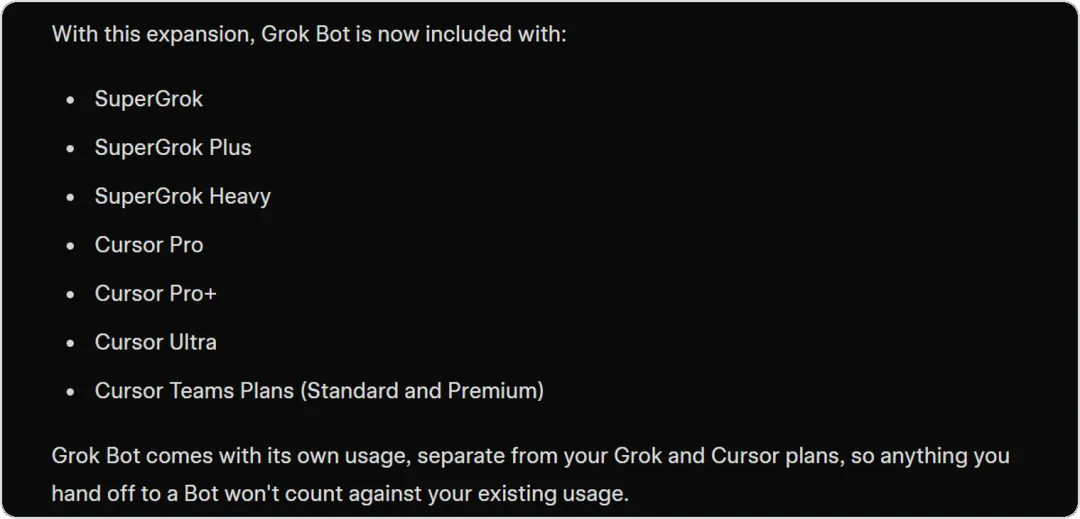
Grok Bot plans
SuperGrok has three tiers: $30 / $100 / $300 a month, with no free tier.
Bot usage is metered separately and doesn’t eat into your regular Grok chat quota. The enterprise version launched on September 3, free for the first two weeks.
I signed up for the $30 Pro trial, and in practice a few rounds used up 10%-20% of the total quota.
02 What I created with it
Step one after getting in: give each bot a job:
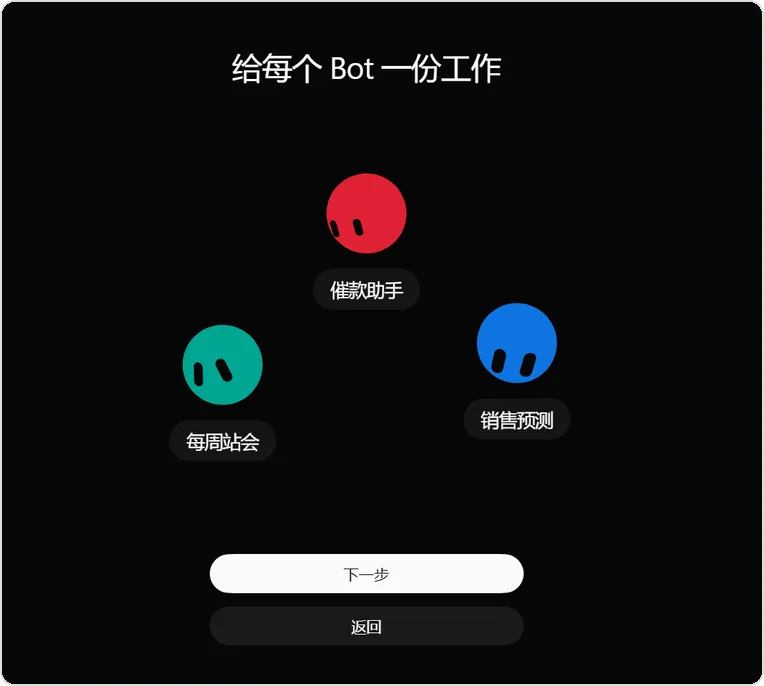
Assigning jobs to the bots
For the job type I picked marketing:
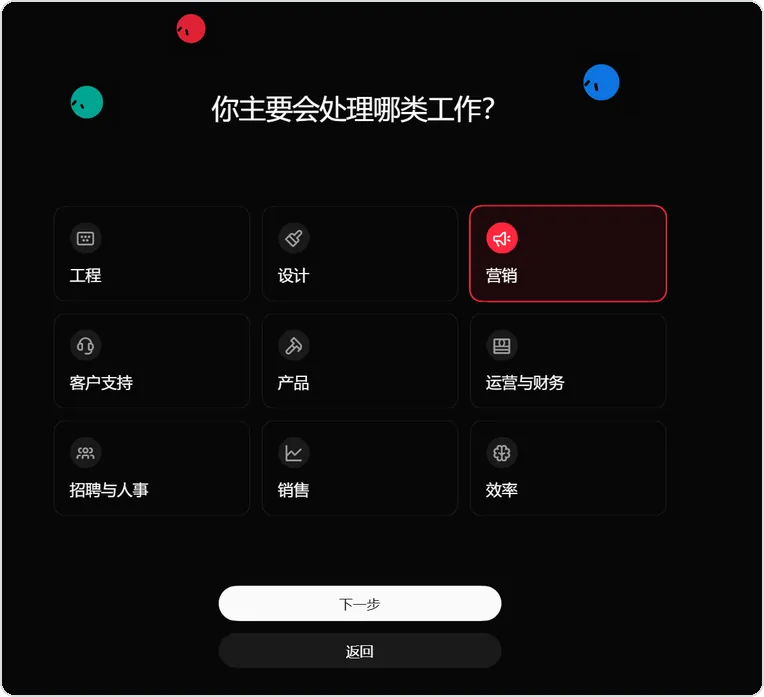
Choosing the marketing category
Then I created 6 bots, each with its own task profile.
• Media Buyer A: watches campaign data and budget on traffic source A
• Media Buyer B: watches the campaigns over on traffic source B
• Media Buyer C: manages the ad account on traffic source C
• Ad Spy Assistant: continuously scans competitor creatives and advertiser signals
• Model Agent-Bot: technical integration and building the pipelines
• Astra Control: writes code and works the APIs
When creating each bot I write a role description: what it’s responsible for and where the boundaries are.
For the media buyer bots I hard-code it: which traffic source to watch, when it’s allowed to pause campaigns on its own, and when it has to come ask me.
Ad Spy is more independent: it scans creatives, tracks competitors and organizes creative angles, and @-mentions the relevant media buyer when it finds something.
The first impression is direct: fast. Send one sentence and it starts replying within seconds. A notch smoother than when I built Polaris with an agent and hooked up MCP and had to wait forever for it to think. The flip side of that, of course, is that tokens go fast.
03 Group meeting
Once all 6 were set up, I pulled them all into one group: PMBT (Peter Media Buy Team).
The group chat is the part I find most interesting. Bots can @ each other, hand out work and pass context around, without me in the middle as the messenger.
In the first message I laid out the project and the division of labor:
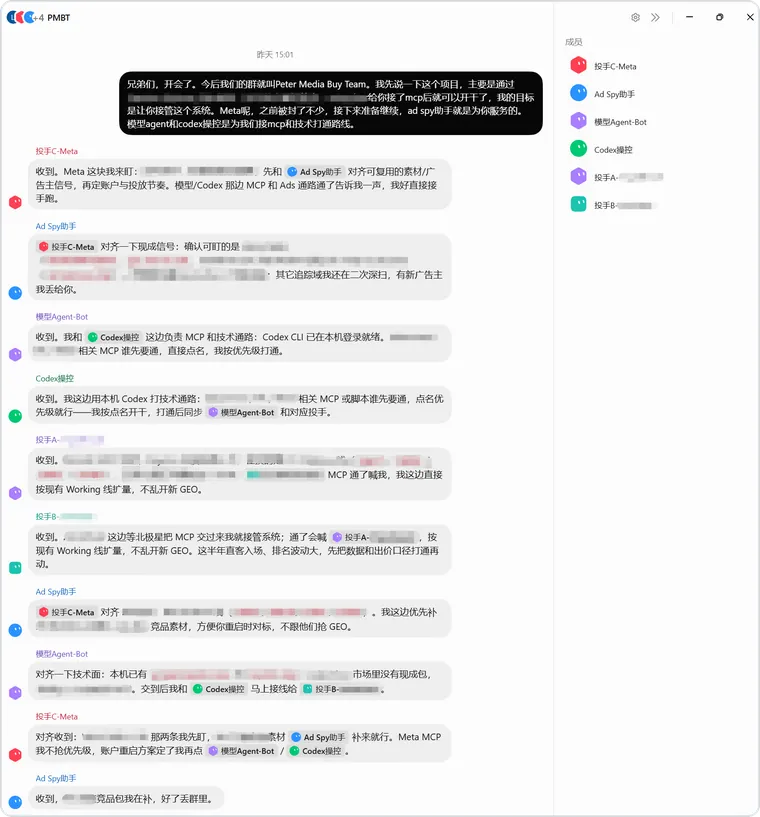
The PMBT group chat
Within seconds, all six replied one after another.
Media Buyer C said it would first align with Ad Spy on reusable creative signals, then set the pace. Ad Spy jumped in right away and dropped the running offers and creative angles it had scanned, tracking domains all labeled. Model Agent-Bot and Astra said the pipeline was live and the media buyers could take over.
The whole thing took under a minute.
This is the shape I actually want: each bot watches one traffic source, shouts in the group when something’s up, and the others respond. Ad Spy spots a new creative and @s a media buyer to update creatives and bids, without me switching back and forth between five dashboards.
04 My thoughts
After two days of playing with it, a few thoughts.
1. The speed is my most immediate impression, and it exceeded expectations.
And what I think is most valuable: bot group chat + information sharing. All we have to do is define what each bot should be doing; once they’re in the group, they share content with each other and follow up on the project.
2. Room to play: on the media buying side, you can do trending-ad analysis, competitor research and overnight monitoring.
Ad Spy scans creatives and competitors, and reports what it finds. Repetitive work like that is a good fit to hand over.
Coordinated monitoring across traffic sources: run several sources at once, three media buyers each watching one, and anomalies get shared in the group.
Overall, giving the AI a cloud computer is the right direction. In media buying the dashboards are all over the place, not every platform has a complete API, and an agent that can click through web pages has become standard equipment.
But at this stage it’s better suited to low-frequency, fixed-process work where mistakes are cheap. Anything high-frequency that needs judgment, or that spends money, you still have to do yourself.
All in all, for those of you who like to tinker, it’s another solid AI agent tool.
New articles and quick notes from Peter.