 Peter Founder
Jev + AI Agent: An Ad Creative Library That Updates Every Hour

Jev
Hi, I’m Peter.
A few days ago I was playing with Jev, the model TypeSafe just released, and it’s pretty interesting.
In short, it’s a model that doesn’t chat and doesn’t write. It only makes judgments. You give it a table, it fills in every cell, and it marks each cell with how confident it is.
Fast, and cheap. The catch is that it only reads text, it doesn’t look at images. I ran it over a platform’s creative library, and here is the process and how it felt.
01 What is Jev
It was released on September 15. This was TypeSafe’s announcement at the time:
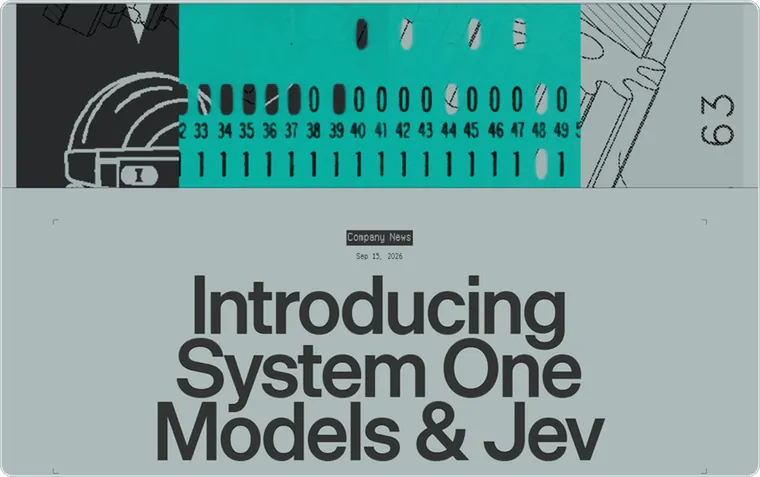
The Jev announcement
It comes down to three things.
It only judges
No chat, not a single word written. It can answer in only three forms: pick one of several options, give a score, or yes or no.
Every judgment comes with a confidence
It tells you how sure it is, and it flags the ones it isn’t sure about on its own.
Fast
One judgment takes 70 to 500 milliseconds, basically a glance.
On price, input is $0.042 per million tokens, and output costs nothing.
It’s cheap because it doesn’t write. Feed the same volume to a large language model and input alone is $0.20 to $10 per million, and output is usually several times more expensive on top.
I applied on the 19th and was approved within an hour:

The approval email
But on the 20th the application form closed again. If you want to try it, you can play with it on Vercel’s AI Gateway, and it can be called directly on Cloudflare too.
In one run I measured, reading 400 creatives used 671,000 tokens, which at list price is under 3 cents.
02 What I did with it
I hooked up the RollerAds creative library; that one platform alone has more than 4,000 creatives.
If you hand those straight to an Agent to sort and analyze, it reads four thousand-odd items one by one, which is slow and burns tokens.
So Jev goes through them first. In the demo, each cell on the left is one push ad, and it lights up as it’s read:
Jev reads 400 creatives in 20.6 seconds
For each creative, Jev answers 12 questions. A few of them:
- Hook: what angle it plays
- Offer: whether there is one, and what it gives
- CTA: what it asks the user to do
- How hard it hypes: scored 0 to 2
- Moderation risk: whether it will get rejected
- Push fit: whether it suits Push
400 creatives, read in 20.6 seconds, 4,800 judgments in total. At that speed, reading all 4,107 in the library takes about three and a half minutes.
After the read, every creative carries a few extra tags, alongside the platform’s own CTR and impressions:
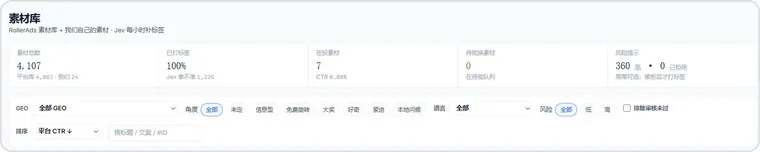
The creative library
Take one example.
#1269 is a UK life insurance ad. The image is just one question, were you born between 1946 and 1976, with two buttons underneath, Yes and No.
On the platform it ran more than 420,000 impressions with a 0.93% CTR. Jev classed it as a curiosity hook, confidence 0.92.
Hype scored 0.42 out of a possible 2. Moderation risk 0.14, and Push fit only 0.47: Jev thinks it’s middling on Push.
Open the creative and Jev’s read is on the right:

Jev’s read of #1269
How it felt: fast. 400 creatives scanned at a glance, a good deal nicer than handing them to an Agent to read one by one. Of course, it only judges; for writing, we still need the Agent.
03 Hand it to the Agent
Once the tags exist, we can sort by our own rules.
Say GEO is Kenya, hook is informational, risk is low, sorted by platform CTR. Four thousand shrinks to a dozen or so in one go.
The ones Jev wasn’t sure about simply don’t get in. The dozen or so that come out are what I call the confident sample.
Only now is it the Agent’s turn. It takes this batch, does rewrites following the hooks and the structure, produces a batch of new copy, and sends it out to test automatically in bulk.
This may be the shape I’ve been looking for: Jev reads and filters the material, the Agent handles testing and rewrites.
The creatives we run ourselves get a 0.08% CTR. The top ones in the platform’s library are around 2%.
The two aren’t measured on exactly the same basis, but the gap is right there. Creatives are the biggest variable in media buying, and finding, testing and revising them is the most time-consuming part.
04 My thoughts
- Fast and cheap is my most direct impression.
And the most valuable part, I think, is reading the material on the Agent’s behalf.
Jev reads and filters the creative library first; the Agent receives a dozen or so confident samples, and tokens are spent only on rewrites and testing.
- Room to play: there’s a lot it can do in media buying.
Tag the creative library, top it up every hour, and new creatives come into the library already tagged. Repetitive work like that is a good fit for it.
Read the whole library and you can also count the market. Of these 400, nearly half the hooks are feature descriptions, more than half never mention an offer at all, and the most common CTAs are “learn more” and “claim”.
That kind of overview is something you never get flipping through them one at a time.
The new copy the Agent produces can also go through Jev once before going live, and anything whose hook has drifted gets sent straight back.
Overall, letting Jev read first and then having the Agent write is the right direction. Media buying has a lot of creatives and a lot of judgments, and if you throw all of it at a large model, the tokens can’t take it.
But at this stage, it’s better suited to jobs like tagging and first-pass screening. What it gives you is a probability; the call is still ours.
In short, if burning tokens hurts, try letting Jev read for you first.
I hope this gives you some ideas!
New articles and quick notes from Peter.