 Peter Founder
Hims Spends $1.1B a Year on Ads: The GLP-1 Weight-Loss Boom
GLP-1
Hi, I’m Peter.
There’s a telehealth platform in the US called Hims. Hair loss, skin, men’s health, it does all of it. But what recently pushed its annual revenue past $2 billion, up 60%, is mainly one thing: weight-loss injections.
How hot are these injections? For most of this year, the overseas traffic crowd has been repeating one word: GLP.
01 First, what this thing is
Strictly speaking, GLP-1 refers to a class of drugs, not any single one.
The ones you hear about most, Ozempic and Wegovy, are semaglutide; Mounjaro and Zepbound are tirzepatide.
They were originally for blood sugar. Along the way, people found they suppress appetite, and more and more people started using them to control their weight. That’s how they took off on the weight-loss side.
How to use them, who they suit, what the risks are: that’s for doctors. We’re not going there, and we’re not giving any medication advice. What I care about is the other end: how a pile of demand this big turned into a traffic business.
02 How big it has gotten
First, the size of the pie.
Hims alone does revenue on the order of $2 billion-plus a year, and it’s still growing fast. The whole weight-loss injection space is far bigger than that: global sales of this class of drugs already passed $50B in 2024.
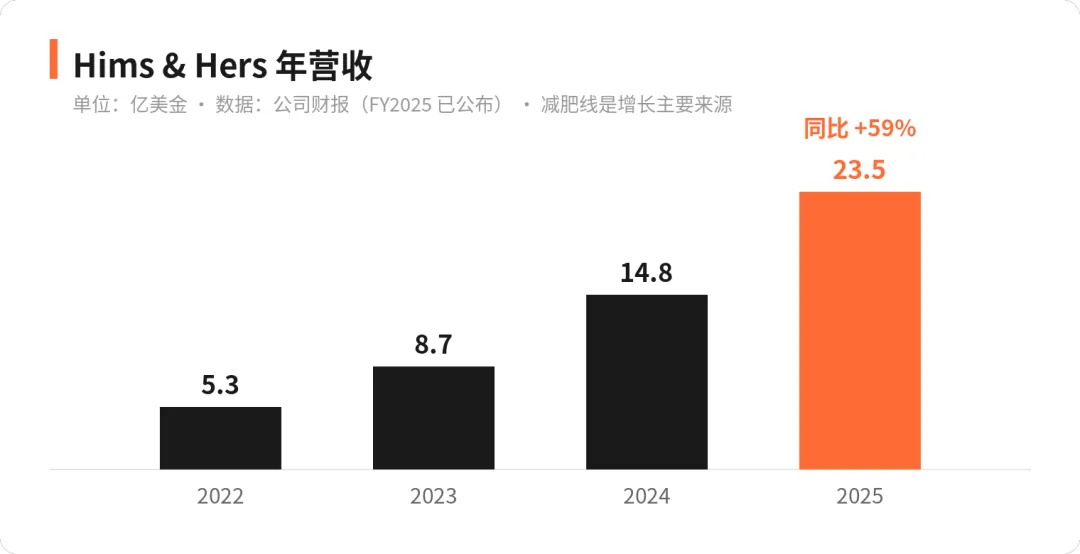
Hims & Hers annual revenue trend: $2.35 billion for full-year 2025, +59% year over year (data: company earnings reports)
The money going to traffic people is real too. Take a long-established platform like GiddyUp: by its own public figures, it has paid out more than $350 million in commissions to affiliates since 2013.
Some people also estimate that a sizeable chunk of the ad budget on Meta is being spent by these “see a doctor and get a prescription online” businesses. Exactly how big a share, opinions differ, but it grows every year.
The figures use different yardsticks, but one thing is certain: this stopped being small change a long time ago. And in the last six months the demand side has fired off two more signals back to back:
- In December 2025, the FDA approved oral Wegovy, the first GLP-1 pill for weight loss;
- In April 2026, Eli Lilly’s Foundayo (orforglipron) was approved, with a cash price starting at $149/month.
From injections to pills, from $1,000-plus a month down to a hundred and something, this pool of users keeps getting bigger.
03 Why it suits paid traffic
The key is how it’s sold.
In the US, there’s an increasingly mainstream way to buy this kind of prescription drug, called an online consultation: you fill out a health questionnaire on a web page, and behind it come a doctor’s evaluation, a prescription and shipping from a pharmacy.
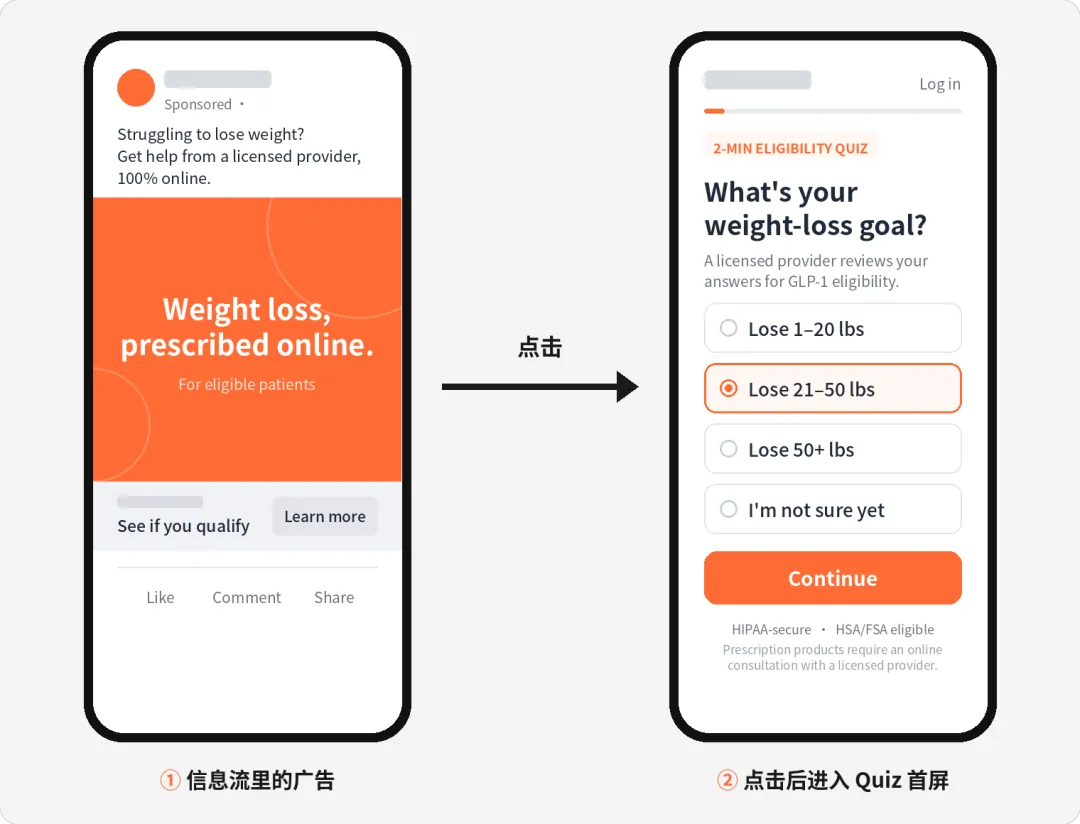
From a feed ad to the first screen of the quiz (illustrative sketch)
From a media buyer’s point of view, this entry point looks very familiar. The front half is a lot like the survey funnels we’re used to running: people click in and answer one question after another.
The difference is what hangs behind it. It’s not an ordinary offer; it’s doctor review, a prescription, pharmacy fulfillment, plus long-term repeat purchases and subscriptions. So it has the easy-to-run side of a survey funnel, but it’s far heavier than ordinary Lead Gen.
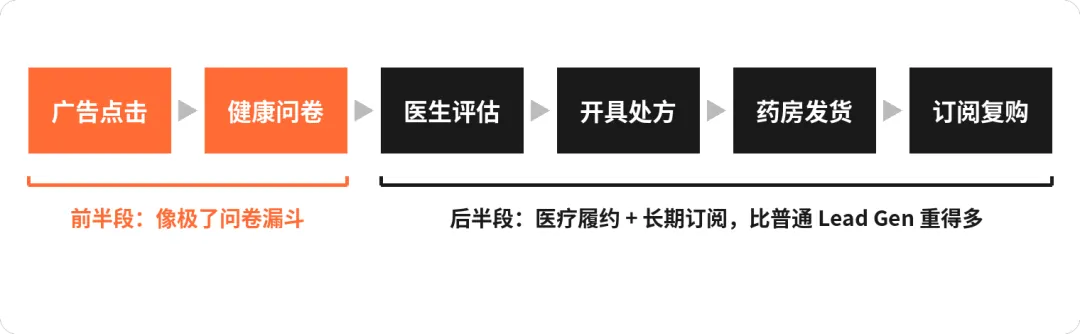
The full online-consultation flow: a familiar funnel
04 Why everyone in our line of work is watching
The reason media buyers have their eye on it is straightforward: it pays a lot.
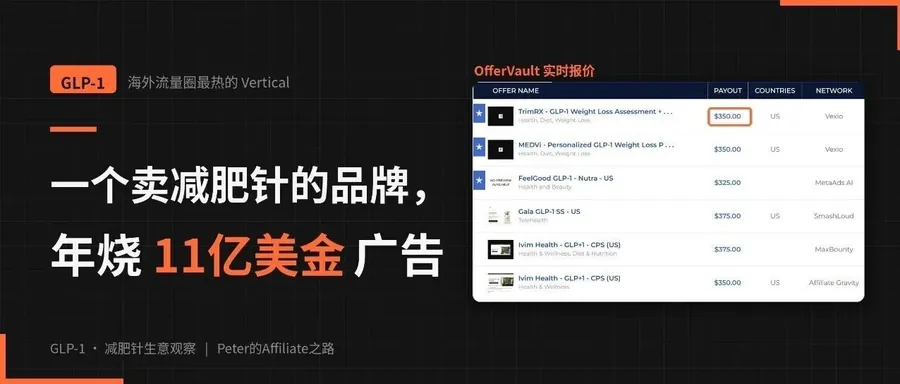
Rates I’ve seen quoted in posts run anywhere from $70 to $500 per conversion. Search “GLP” on OfferVault and the first screen shows exactly that price range:
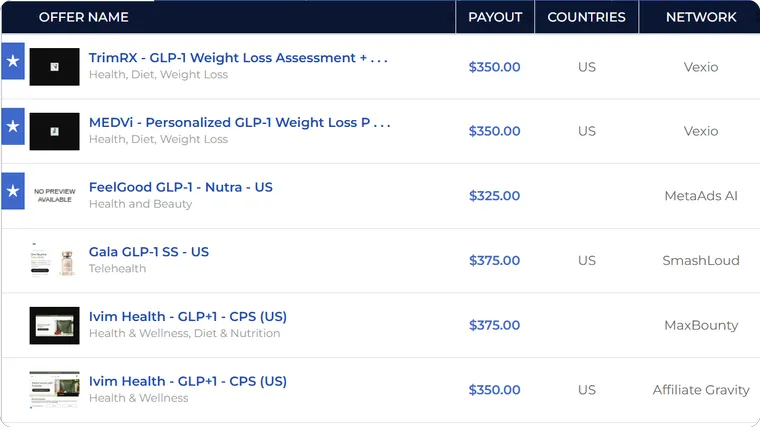
GLP offers on OfferVault, payout $325–$375
Of course that’s not a uniform price; it varies a lot by brand and by network. But compared with ordinary weight-loss products, or with Sweeps, it’s a notch higher.
Still, a high payout doesn’t equal high profit. In this business, the catch is further down the line:
- What counts as a valid conversion? Finishing the questionnaire, the doctor approving, or paying for the first order: the difference is huge;
- Caps, holds, refunds, chargebacks, subscription churn: every one of them eats into your margin;
- Fulfillment on the pharmacy side isn’t in your control either.
The barrier to entry is high too. The exclusive offers that actually make money are mostly Private offers negotiated directly with the brand, and you need specially reviewed, qualified ad accounts to run them. It’s not something you do by just opening an account.
I ran weight-loss Nutra in my early years, so this direction isn’t foreign to me.
But one thing needs to be said clearly: a GLP medical questionnaire looks like a Survey, but what people type into it is their health information. You can’t split traffic by their answers, drop pixels and run retargeting the way you would with an ordinary offer. On privacy and compliance, the price of crossing the line here is far heavier than losing a Sweeps account.
05 My take
For most people in the community, GLP isn’t a vertical you can jump into right away. Direct advertisers, qualifications, accounts: every one of them is a hurdle.
But it’s worth keeping an eye on. It lays the blockbuster pattern out plainly: the money is moving toward businesses where the demand is real and the repeat purchases are long-term.
New articles and quick notes from Peter.