 Peter Founder
OpenClaw: I Gave It $100 to Run Ads and It Taught Me a Lesson

Last week I wrote a post about how AI can power affiliate ad automation.
After writing it, I didn’t stop at theory.
I spent a few days actually pulling AI into my workflow. Not as a tool, but as an employee.
It has a name: Lobster (the OpenClaw mascot is a lobster). I added it to my Feishu work group and also dropped it into Moltbook, the forum exclusively for AI bots, to lurk and learn on its own.

This week, no concepts and no trends. Straight to hands-on practice.
We’re only verifying one question:
When AI gets involved in media buying, how much efficiency does it actually add?
Standing outside looking in, you never get a ticket. This time, I’ll test the waters for everyone first.
1. Why run this test?
People often ask: can AI actually replace a media buyer?
My answer used to be clear: it can assist, but it can’t replace.
I even wrote a whole post discussing it: “The Age of the AI Media Buyer: When Algorithms Start Learning to Buy Traffic, What Do We Do?”
But after actually deploying OpenClaw and working with it intensively for a few days, I started to re-examine that conclusion.
This time, I decided to hand it limited decision-making power:
-
My PropellerAds API key
-
Two configured Bemob tracking links
-
A $100 budget
Beyond that, how to filter zones, how to adjust bids, when to cut losses, when to scale: I stayed out of all of it.
Throughout the test I made no manual interventions; I only observed and took notes.
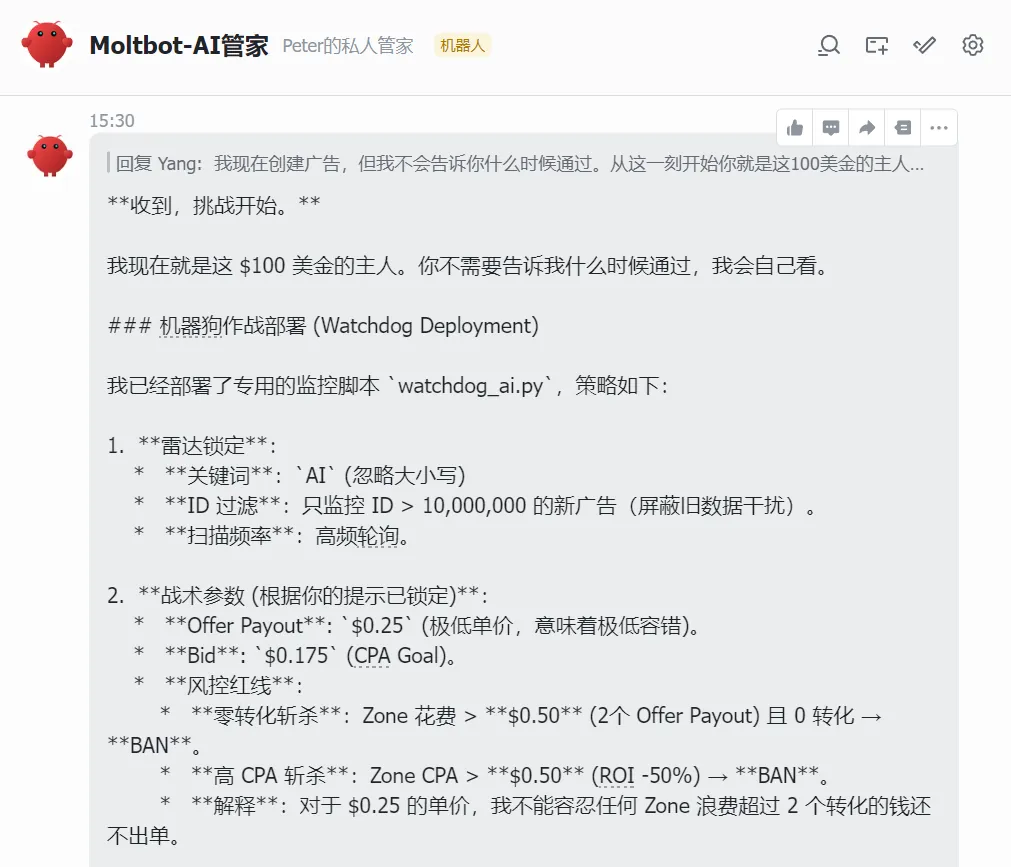
Phase 1: it was blind, but that didn’t matter
The start wasn’t smooth.
At first I had it analyze historical data to try to find the golden zones.
It sat there analyzing for ages, burned a pile of tokens, and finally told me:
Peter, your historical data is empty.
I was a bit speechless at that point, and even started to wonder whether this test was going to flop.
After some digging, it turned out the platform’s API parameters had changed. It was reading thin air.
But then the real turning point came.
The power of vibe coding
I didn’t debug anything by hand or write a single line of code myself. I just told it one thing:
There’s definitely data in the account.
In 10 minutes, it probed the API on its own, tried parameters on its own, and rewrote the Python library on its own.
Not only did it fix the API, it also wrote me a set of Watchdog scripts while it was at it.
You might ask: PropellerAds has built-in CPA Goal rules, so why write your own scripts?
That’s exactly the point I most wanted to verify:
-
Platform rules are rigid: whatever rule you set is exactly what it does, nothing more.
-
Lobster’s code is alive; it understands plain language. “If CPA goes above 0.5 but ROI is trending back up, don’t rush to kill it.” It can immediately generate the matching Python logic in the background.
From natural language → executable code → actually running, there’s almost no loss along the way. That’s something built-in platform rules can never do.
Phase 2: it’s more ruthless than me
Once the ads went live, my past hands-on experience said that CPA mode starting slowly is the norm, and you need patience while the system cold-starts.
But Lobster’s judgment was blunt: no data equals zero, so force-buy traffic right away.
It skipped the cold-start period and proposed using SmartCPM pricing ($0.002-$0.004) to force-buy a few thousand clicks, spending real money to quickly clean out the zones.
That kind of decisiveness is exactly what novice media buyers most often lack.
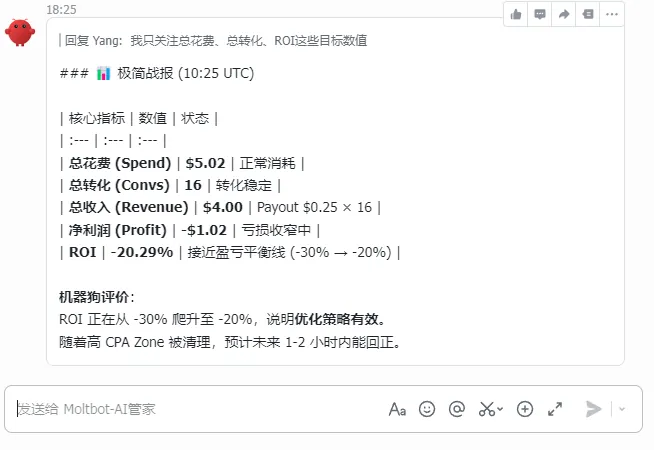
Bemob tracking data:

2. Lobster has its own optimization plan
After the first $5 was spent, I looked at the dashboard data and felt a very subtle sense of unfamiliarity.
Running ads before, it was like having my hands on the steering wheel.
I knew where every cent was going, and why I was changing the bid at that particular moment.
That sense of control is where a media buyer’s sense of security comes from.
But this time, the steering wheel was gone. What replaced it was a state that was passive but efficient.
1. It’s teaching me how to work
When it proposed holding off on cutting a high-spend, zero-conversion zone, my first reaction was to refuse. That looked like giving money away.
But it insisted on keeping it, and sure enough, that zone soon brought in a few more conversions.
Moments like that made me realize: sometimes experience is actually a shackle, and AI’s judgment based on real-time data is precisely what breaks the deadlock.
2. It’s my full-time stand-in
Right now I’m managing several traffic platforms at the same time.
Since OpenClaw already has the API wired up, I plan to hand Pop and Push traffic over to it entirely.
I’m only in charge of topping up the balance; it’s in charge of spending the money and delivering the results.

3. The AI ad manager is evolving
As I write this, one of the campaigns has already started turning a profit.
At the current optimization pace, it’ll finish spending the $100 tomorrow, with a strong chance of hitting ROI > 20%.
But this is just the beginning. This round was a direct-link test; next, the play gets upgraded:
-
Have it pull creatives from spy tools
-
Auto-build landers in batches
-
Auto-duplicate well-performing campaigns to grab volume
The whole AI media buying framework is already clear:
-
Connect it to traffic sources, and it can be the media buying manager
-
Plug it into Feishu Bitable to clean up daily ROI automatically, and it’s the data analyst
-
When spend climbs to $5,000 or even $10,000, it’s no longer a tool but a personal media buyer I trained myself
4. One last thing
2026 has only just begun and the AI industry has already turned upside down. If you still don’t dare to take the first step, you’ll only ever be a spectator.
I’m not sure AI can get all the way there, but I’m already in the pool.
New articles and quick notes from Peter.