 Peter Founder
Why Your Campaigns Keep Crashing: The Opposite of What You Think

Anyone doing media buying can run into this on any given day: a campaign has just started to pick up, and we rush to add creatives, adjust bids, add targeting, cut zones and swap offers. Then it crashes.
At first you assume the offer is bad or the traffic quality is the problem. But there’s another possibility: the one who really crashed the campaign might be you.
A cautionary example
I used to run Facebook Sweeps. Two weeks in, ROI kept swinging between -20% and -40%. My mindset at the time: something must not be tuned right.
So I was changing things every day: swap creatives today, adjust the audience tomorrow, add exclusions the day after, change the bid the day after that. Every day I felt one more tweak would get it profitable.
The result: the more I changed, the worse it got.
The reason is simple: every time you change a variable, the data you’d accumulated before gets contaminated. You don’t know whether ROI got worse because the new creative is bad, because you adjusted the audience at the same time, or because the algorithm is relearning.
When you move 3-4 variables at once, you can no longer tell which one is driving the results. That’s data contamination. Once the data is dirty, all your optimization is throwing darts blindfolded.
Later I did the opposite: kept just one set of the best creatives + the broadest audience, and touched nothing else. After three days the data actually stabilized and ROI came back to +30%. Then I did a round of horizontal scaling, which was much easier to control.
Try thinking in reverse
Most beginners’ default mindset is: the campaign isn’t profitable because I haven’t optimized enough.
But the truth is usually the reverse: the number one reason a campaign crashes isn’t too little optimization, it’s too much.
That doesn’t mean you don’t need to optimize. It means optimization has a rhythm; logging in and poking at it every day isn’t optimization.
My approach is to split a campaign into several phases, each with a clear spend threshold. Until you’ve hit the threshold, don’t touch it. Once you’ve hit it, let the data decide whether to cut or continue.
Test phase: set the daily budget at 5-10 times the payout, test 6-12 sets of creatives, and only cut, never add. Those words, only cut, never add, are the core. Your job is to filter the best out of a pile of candidates, not to keep stuffing new ones in.
After spending 10 times the payout, look at overall ROI: better than -30%, keep optimizing; between -30% and -60%, judge carefully; worse than -60%, swap it out decisively. Many people rush to cut at -40% ROI, but -40% may only need one round of whitelisting to have a chance of turning positive.
Rushing to cut = the test budget you already spent was wasted.
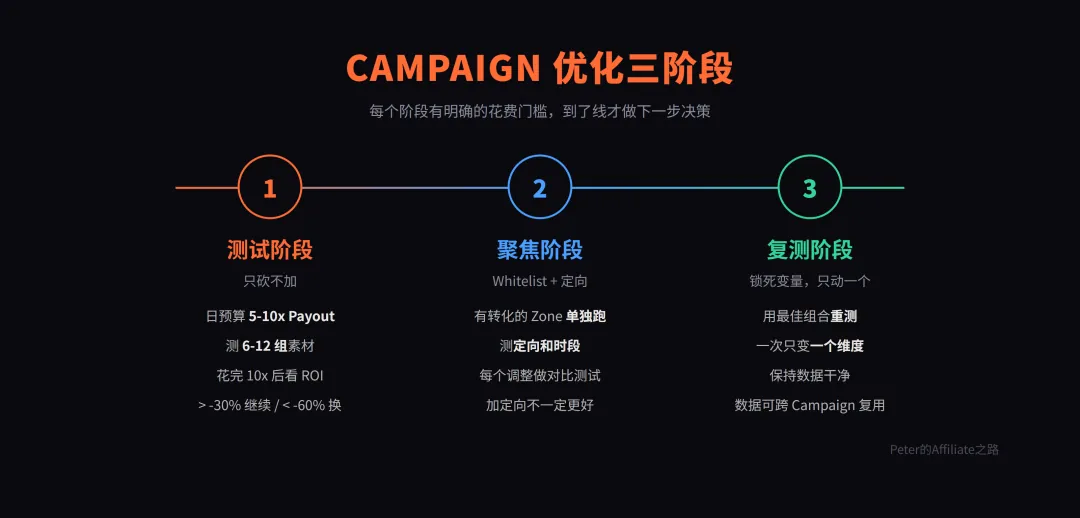
Focus phase: take the zones that have conversions and run them separately, while testing targeting and dayparting.
But there’s a trap here: adding targeting isn’t necessarily better than not adding it, because your settings may conflict with the platform’s algorithm. Every adjustment needs a comparison test; don’t take it for granted.
Retest phase: take the best combination you’ve already validated and retest it, changing only one dimension at a time. Lock down every other variable and move just one. That’s the discipline that keeps data clean.

A few rules to start from
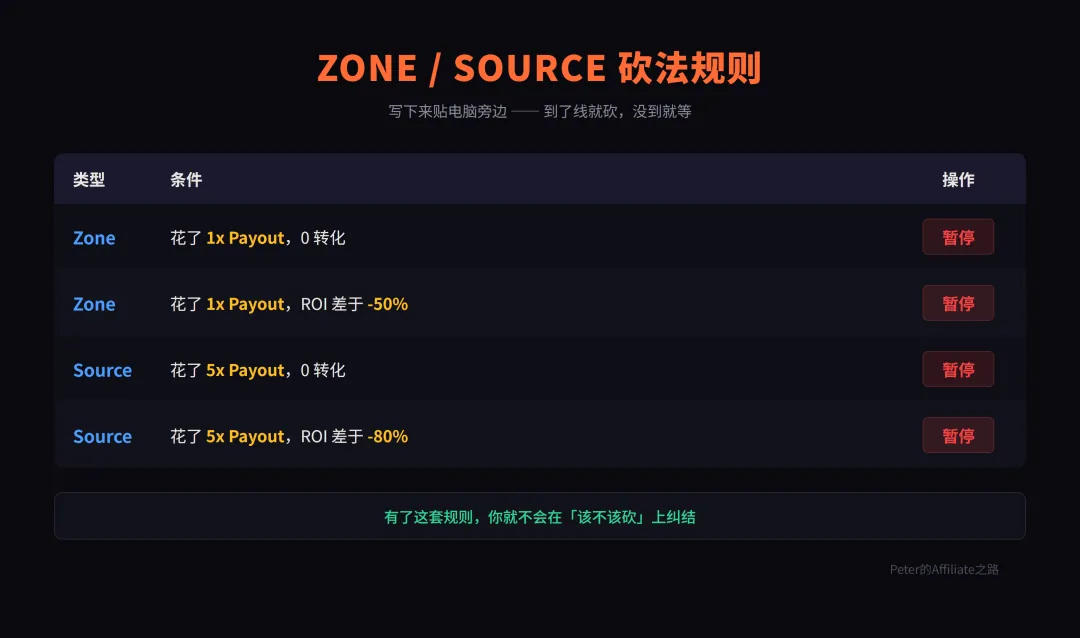
How to cut zones and sources, for example, set it up like this:
-
A zone has spent 1x payout with 0 conversions → pause
-
A zone has spent 1x payout with ROI worse than -50% → pause
-
A source has spent 5x payout with 0 conversions → pause
-
A source has spent 5x payout with ROI worse than -80% → pause
A source is an aggregate of many zones and fluctuates more, so its ROI threshold is looser than a zone’s.
Hit the line, cut; not there yet, wait. With this set of rules you’ll stop agonizing over whether to cut.
Why leaving it alone is a skill
People new to the industry log in every day, see the numbers move and can’t resist making a change. That’s the one thing you shouldn’t do.
The logic behind it: what your money buys isn’t just traffic, it’s data. Every dollar you spend is telling you which people, at what time, on which device and in which place are more likely to convert. That data only has reuse value while it’s clean.
For example, back when I ran Push I built up a lot of zone-level data. When I switched offers later, I reused it directly and saved a lot of test budget. If I’d been fiddling with it every day back then, that data would have been worthless long ago, because you simply couldn’t tell which parts were usable and which weren’t.
Data is your most valuable asset, worth more than any single campaign. Campaigns crash; clean data doesn’t.
One last word
Why do your campaigns keep crashing? Don’t rush to look for external causes. First ask yourself three things:
Am I changing too many variables at once?
Do I have a clear standard for how much to spend before I cut?
Is my data still clean?
Most of the time, one of the reasons a campaign crashes is us.
New articles and quick notes from Peter.