 Peter Founder
Case Study: 1-3-3 + Manual Targeting Hit 26.87% ROI in 2 Months
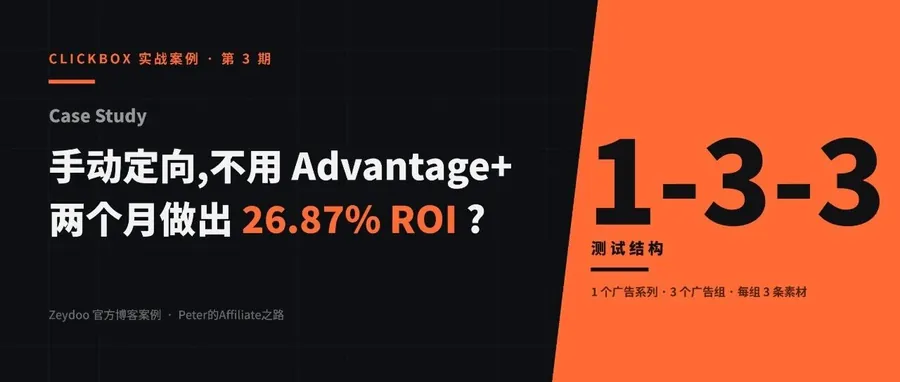
CLICKBOX Case Studies · Issue 3
This issue is a case Zeydoo’s official blog published in May: another affiliate running Clickbox on Facebook in the Philippines and Mozambique, netting $1,721 in two months at 26.87% ROI.
His approach differs from the case in my last issue in a few obvious ways: a 1-3-3 test structure, a commitment to manual targeting, and a three-person team. Read this one alongside issues 1 and 2.
Yet another case confirming how well Facebook and Zeydoo’s Interactive offers fit together. Yes, it’s Clickbox again.
There’s no magic bullet here, just solid optimization: low-cost GEOs, manual targeting, continuous creative testing, and a 26.87% ROI at the end of it. It’s also a good reminder that ongoing manual work and data-driven decisions still matter. Automation alone isn’t necessarily enough. Let’s break it down step by step.
Performance data
Here is the data for the two months from November to December 2025:
| Metric | Data |
|---|---|
| GEO | Philippines + Mozambique |
| Traffic source | Facebook (Social) |
| Run period | 2025/11/01 – 2025/12/31 |
| Offer | Zeydoo Clickbox |
| Tracker | Skro |
| Spend (ad cost) | $6,411 |
| Revenue (generated on the Zeydoo offer side) | $8,133.69 |
| Net profit | $1,721.82 |
| ROI | 26.87% |
Targeting settings: Android + iOS, smartphones only, mobile data only (4G).
Note: this case shows the data from the two best-performing GEOs. The author also recommends Brazil, the Philippines, Ghana, Malawi, Zambia, South Africa and Kazakhstan, all GEOs that are relatively cheap to test.
Why he chose Zeydoo
“I had heard of Zeydoo long ago, but the discussions on forums gave me a completely different view of this network. After reading case studies from affiliates like Amixo and Desha, I decided to test it myself, and that’s what brought me to where I am today.
Before joining Zeydoo I also tested other networks, but never got the same results. I think Zeydoo’s offers are more diverse and perform better: as long as you send high-quality traffic, they convert. Clickbox is one of the best choices on Zeydoo, but it is very demanding on creatives and GEOs, so you have to test several countries until you find a combination that produces ROI.”
Before launching: three iron rules
After years in the trenches with Meta, Google Ads and multiple networks, he set himself a strict set of rules:
- Data over emotion. Fluctuations are always part of the process, so decisions must be based on CTR, CR, ROI and CPC, not gut feeling.
- Testing is mandatory. GEOs, creatives, audiences and offers all need continuous testing, across multiple variables, not just two or three creative versions and done.
- Progress gradually. Run many small campaigns instead of aggressively scaling a single combination. At the same time, avoid testing too many combinations at once, or optimization becomes very difficult. Keep a steady creative testing rhythm.
Basic testing: four key points
1. Budget
Meta lets you start testing on a very small budget. You can launch for as little as $2, while the threshold on other channels is usually $10. When you’re testing a large number of variables, that gap gets amplified significantly. For someone like him who tests a lot of creatives, this is especially critical.
2. A strict test structure: 1-3-3
1 campaign, 3 ad sets, 3 creatives in each ad set. This structure makes it easy to compare creatives one by one: each creative’s CPC can be monitored individually, and when one starts getting expensive or slipping, it can be adjusted or replaced quickly without affecting the structure of the whole campaign.
The structure at a glance:
| Level | Setup |
|---|---|
| Level 1 · Campaign ×1 | 1 budget · 1 objective |
| Level 2 · Ad Set ×3 | CPC monitored separately per ad set |
| Level 3 · Creatives ×3 / ad set | Scale the winners · keep the passable · cut the losers |
3. Audience targeting
Performance on social media (especially Meta) depends heavily on grabbing attention fast: the creative has to hook, and the audience has to be genuinely interested in your ad. There are two ways to find audiences: one is Advantage+, Meta’s automation tool that finds the people most likely to convert on its own; but he sticks to manual targeting, which in his experience is the only way to get consistent results.
4. Multiple campaigns in parallel
Don’t rely on just one or two campaigns. Test as many GEOs, creatives and offers as you can. The benefits:
- Budget per campaign stays small
- Avoids the ROI drop that comes from overspending
- Builds better data (CR, costs, etc.)
- There are always new GEOs, new creatives and new offers in testing
Note: this does not mean cramming every variable into the same campaign and testing them all together, which would make optimization extremely difficult. So, back to the 1-3-3 from point 2.
Why Facebook
“Facebook is one of my main traffic sources right now, because it lets me test on smaller budgets and validate campaigns faster. It also lets me scale multiple creative sets, GEOs and offers at the same time, and keep optimizing based on performance and user feedback.”
The creative formula: Curiosity + Pain + Solution
He has an iron rule for creatives too: a good creative must contain three elements, Curiosity + Pain + Solution. Hit all three and the creative has strong conversion potential.
Here is a real example from the campaign:

Tracking and optimization
All campaign monitoring is done in Skro, used to quickly identify what’s working. His principle never changes: decisions are based on metrics like CTR, CR, ROI and CPC, not on feelings.
“In the early stage, lots of testing, breaking even or even losing money is normal. Campaigns simply need optimization. Someone else showing off $1K/day doesn’t mean you’ll get there fast too. What you need to build is an ecosystem.”
The other key is optimization speed: weak creatives get adjusted or replaced immediately, and strong combinations get extra attention and budget immediately. To speed up optimization, he works with two teammates. In his words, validating results on your own is much slower.
The process cheat sheet
The whole approach compressed into 5 steps:
Step 1 · Start small. Low budgets, with multiple GEOs, creatives and offers in parallel.
Step 2 · Use 1-3-3. Compare creatives one by one and control each one’s CPC individually.
Step 3 · Grab attention. Every creative needs Curiosity + Pain + Solution.
Step 4 · Watch the data. Follow CTR, CR, ROI and CPC, not your gut.
Step 5 · Optimize fast. Swap weak creatives right away and scale gradually.
Results
In two months, Clickbox brought in $1,721.82 in net profit. Below is the data from the tracker side and from the Zeydoo dashboard:

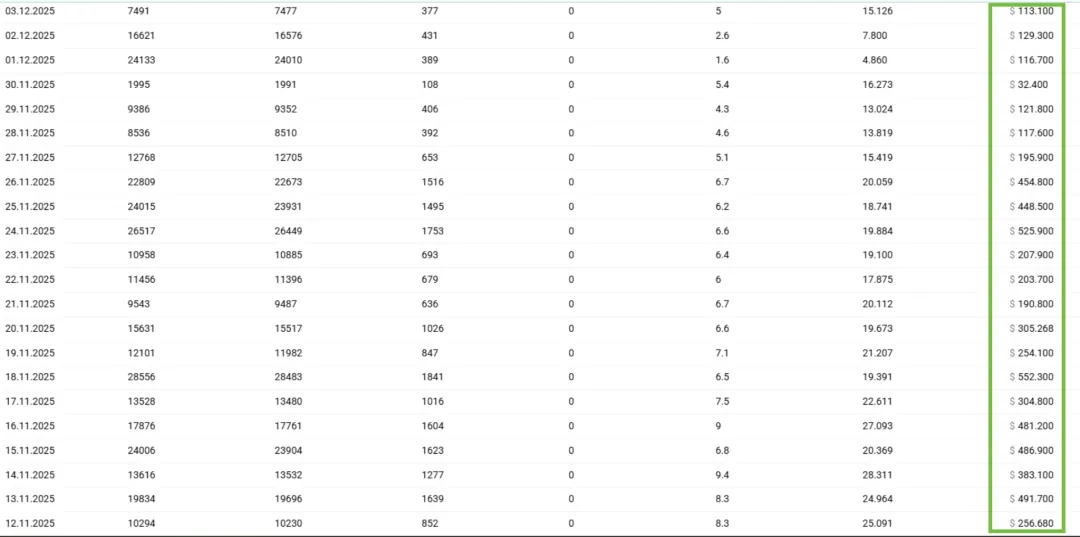
Zeydoo dashboard | filter “Best for Facebook” | check GEO eCPM
Income and ROI figures here are past results of one person or case, not typical outcomes. Paid traffic can lose money; start with a small test budget.
New articles and quick notes from Peter.