 Peter Founder
Case Study: How This Facebook Ad Kept Running for 5 Months
Today I’m sharing a case study about Facebook traffic.
The author is Bin, a programmer based in China with 6 years of affiliate marketing experience, and he’s also a member of our community.
Over the past two years, his focus has gradually shifted to Facebook traffic, and Zeydoo has become his core partner.
From testing to scaling, he does all the work himself, which naturally shapes a different way of making decisions. Every test, every optimization, every mistake carries a direct cost.
That led him to one core belief:
“In this industry, what really matters isn’t how much you make from a single campaign, but how much lasting value the thing you build can keep creating.”
This isn’t a story about a successful campaign. It’s a story about a framework: how to turn ad campaigns into long-term assets instead of starting from zero over and over again.
Why Zeydoo + Facebook
Bin first worked with Zeydoo back in 2023 and recently came back with a clearer, more structured strategy. Choosing the Zeydoo + Facebook combination was a deliberate decision, because this setup lets you scale sustainably over the long term.
Zeydoo’s key value lies in its unique product ecosystem:
Interactive offers — redesigned, out-of-the-box simple interactive flows, such as quizzes or playable ads, that guide users through to conversion.
They come with optimized, compliant prelanders, so you don’t have to build a funnel from scratch. That means you can put all your energy into creatives and traffic, the two factors that really determine performance.
Operational support — reliable payouts, responsive AMs, traffic quality feedback. These matter especially for solo affiliates.
Zeydoo’s interactive offers perform particularly well on Facebook traffic. They fit naturally with high-engagement creatives, which makes them a great choice for this strategy.
For affiliates who are just starting out or testing a new angle, the recommended entry point is:
MIX | TOP Offers | Smart Rotation
This mix funnel automatically routes traffic to the best-performing offers, simplifying testing and helping you find scalable combinations faster.
On the Facebook side, you get more than reach and targeting: you get an algorithm that rewards consistency. Long-running campaigns keep accumulating data, improve audience matching and gradually bring CPMs down.
“On Facebook, time isn’t a cost. It’s an investment.”
Campaign data
Here is the data from his campaigns in February 2026:
| Metric | Data |
|---|---|
| GEO | PH |
| Traffic source | |
| ROI | 62.27% |
| Spend (Bin's ad spend) | $5,033 |
| Revenue (generated on the Zeydoo offer side) | $8,241 |
| Net profit | $3,134 |
| Offer | Zeydoo Fixed CPL (Playable | Click Box 19037) |
What makes this data really interesting isn’t the numbers themselves, but where they come from.
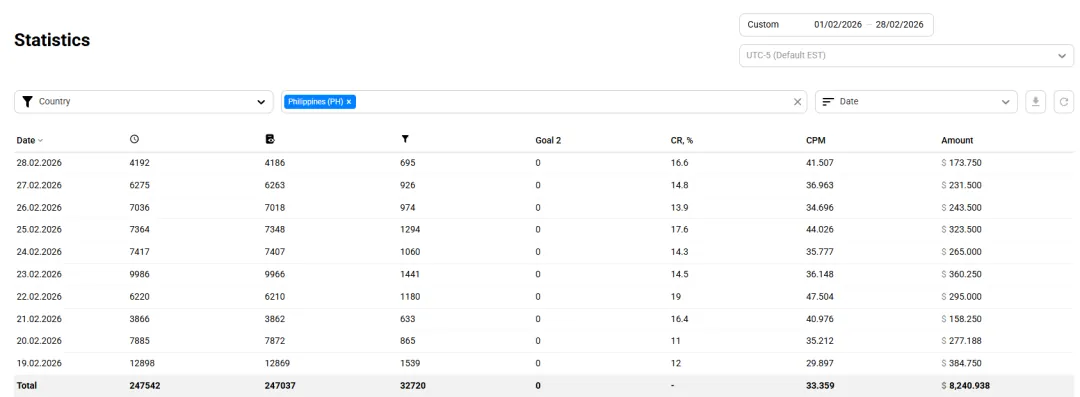
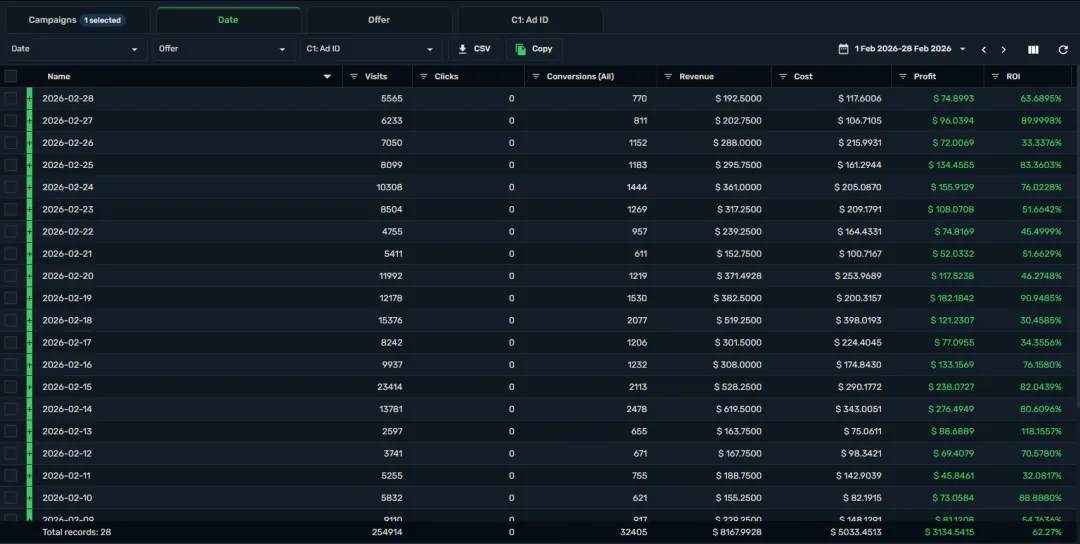
The vast majority of the revenue came from just 3 Facebook ad campaigns, and those 3 campaigns have been running continuously for nearly 5 months.
That’s very rare in Facebook advertising. In most cases, affiliates are forced into frequent interruptions by creative fatigue, review issues or account restrictions, and end up stuck in an endless restart loop.
But in this case, the campaigns kept running because he built them with a different mindset from the very start.
Asset mindset vs. short-term mindset
In the past, many affiliates were used to running interactive offers with “aggressive, eye-catching” creatives. That approach often did deliver high CTRs and fast returns.
But for long-term success, keeping campaigns clear and consistent is what matters. A simple message and a clear value proposition usually perform better over time.
At the same time, Facebook’s review is getting stricter. It now checks not just the text, but the visuals and the overall message as well. This became especially obvious after the March 2026 update, when large numbers of ad accounts and campaigns were restricted as a result.
For many affiliates, that meant losing all their accumulated data and stable income overnight.
What makes an ad a long-term asset
Once you switch from quick profits to long-term performance, your creative strategy has to change with it.
The core idea is simple: play by the rules and focus on genuine engagement. If your campaign is compliant, the platform is more willing to keep sending you traffic.
Instead of chasing aggressive promises, put the focus on sparking real interest from users.
Specifically:
Don’t force the click. Spark interest instead. Clickbait headlines may bring traffic in the short term, but they’re not sustainable. Ads that genuinely get users involved perform more consistently.
Engagement matters more than clicks. When users like, comment and share, it helps both performance and scaling.
Keep the message clear. Stay concise and encourage users to interact.
Use curiosity. Don’t give everything away up front. Keeping a little mystery drives clicks and engagement.
At its core, Bin’s approach is built around engagement mechanics, but he isn’t willing to share the actual creatives publicly because these campaigns are still running.
Still, the idea is clear: his concepts closely match how interactive offers work — spark curiosity, encourage participation, generate engagement naturally.
Most importantly, this approach is better suited to long-term scaling.
At the same time, not every concept works everywhere:
“Some creatives work extremely well in Southeast Asia, but in Africa or Latin America, different cultural elements perform better. The right approach always comes from testing.”
This highlights the importance of localization: visuals and messaging need to be adapted to the cultural background of the target audience.
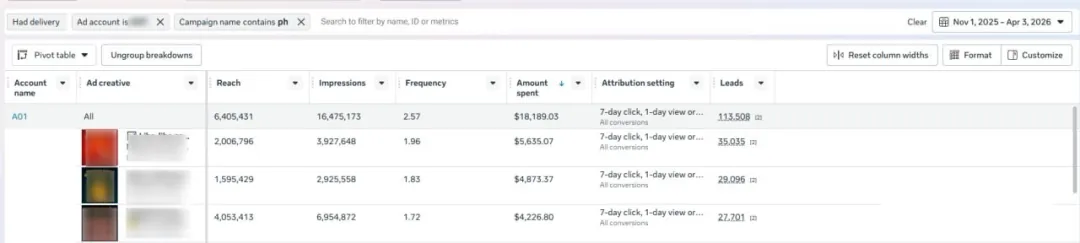
Bin shared the creative-level data to show how the campaigns performed over the long run. The initial data only covers February, but in reality the campaigns had already been running profitably for several months.
The data shows that only a handful of creatives generated most of the leads and spend. This confirms the point: treat campaigns as long-term assets, not short-term tests.
Bin also pointed out a data discrepancy:
“Possibly for technical reasons, the number of leads Facebook reports is about 10,000 lower than the actual figure.”
How the creatives are made
The whole creative process is built on: research + AI + continuous testing.
Before launching, he researches existing ads with tools like Meta Ad Library. The goal is to find creatives that have already been running for a long time, which is a strong signal that they work.
AI helps generate ideas, such as angles, hooks and engagement mechanics. But everything is adjusted by hand and fine-tuned for the target audience.
Once a campaign is live, decisions are based entirely on real data. User behavior, engagement and conversion data tell you what works.
Over time, this builds a unique creative methodology that can’t be copied without the same accumulated data.
From testing to scaling
During testing, multiple creatives go live at the same time under controlled budgets. CTR is monitored too, but the main focus is engagement quality, especially user comments and organic interaction.
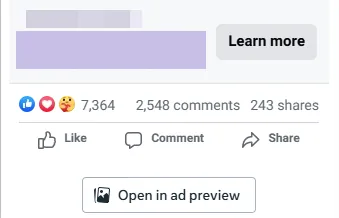
“When users start engaging naturally, not just clicking, that’s usually the first signal of long-term potential.”
Once a strong creative is found, the strategy shifts to concentrated scaling.
Instead of spreading budget across multiple campaigns, Bin concentrates his firepower on the one with the most potential. He runs multiple ad sets off the same post, so engagement keeps accumulating, strengthening social proof and improving delivery.
Meanwhile, scaling tools like Cost Cap and Bid Cap help keep efficiency up while volume increases. Lookalike audiences extend reach further by finding new users who resemble those who have already converted.
The end result is a compounding effect: more engagement, higher relevance, lower CPMs, stable performance.
At this stage, the campaign is no longer just an ad. It has become a long-term asset inside the platform’s ecosystem.
Final thoughts: play the long game
Affiliate marketing has long been tied to short-term gains and aggressive tactics. But as platform policies evolve, that playbook is becoming more and more fragile.
The alternative: build for the long term.
“Every compliant campaign accumulates value — for your account, your creatives and your overall strategy.”
Unlike short-term tactics, these campaigns don’t disappear with the next platform update. Instead, they become a sustainable competitive advantage.
Zeydoo’s ecosystem, especially its interactive offers, combined with Facebook’s algorithm, provides a solid foundation for this approach.
For affiliates who want to break out of the “endless restart” loop and build a scalable system, this model offers a clear direction.
- https://app.zeydoo.com/offers/22839
- https://app.zeydoo.com/offers/19037
- https://app.zeydoo.com/offers/top/20418
Long-term assets aren’t built overnight, but they compound over time.
This is a case study Bin wrote for Zeydoo. I organized and translated it by hand, and it’s worth reading a few times.
— Peter
If you’re interested in signing up for Zeydoo, feel free to contact me.
Income and ROI figures here are past results of one person or case, not typical outcomes. Paid traffic can lose money; start with a small test budget.
New articles and quick notes from Peter.