 Peter Founder
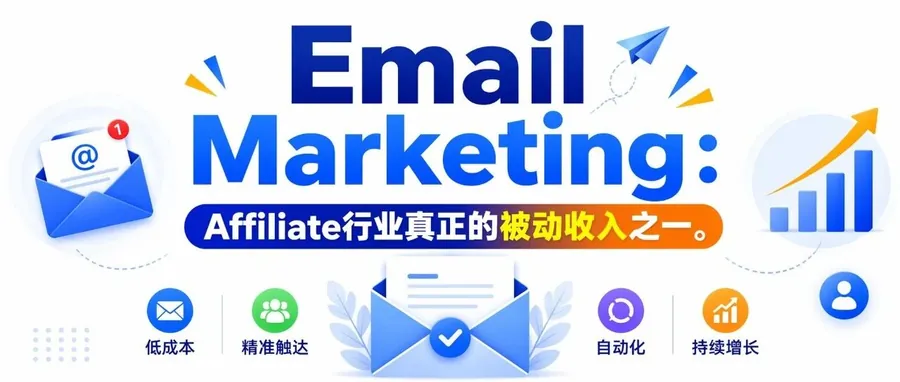
Email Marketing: A Real Passive Income Stream for Affiliates
A while back I mentioned Lifetime Commission as a form of passive income, and a lot of people running offers were pretty interested.
Because whether you’re running Facebook, Google or TikTok right now, the moment an account gets into trouble and banned, your income usually drops to zero on the spot.
What hurts more: every cent of ad spend, every click you paid for—once the user leaves, they’re gone, and nothing is left behind.
It feels great while the money’s coming in, but look at it from another angle: when the traffic stops, what do we actually have left?
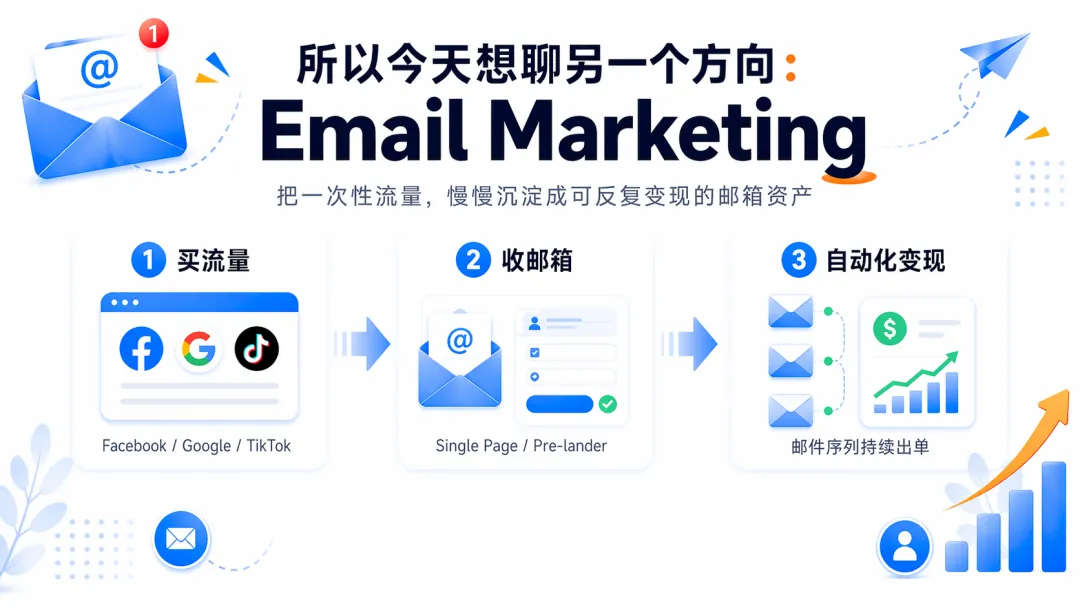
So today I want to talk about a different direction: Email Marketing.
Why do people overseas keep building email lists?
Let’s start with a very basic fact:
I’m sure most of us don’t really read email, so some people assume Email Marketing doesn’t work.
But in the US and European markets, email is a mainstream communication tool. Users open their inbox about as often as we scroll WeChat Moments.
That means if you have a targeted email list, you can:
-
Reach the same users over and over without paying for traffic every time
-
Promote multiple offers instead of a one-shot deal
-
Stay independent of any ad platform: if an account gets banned, the list is still in your hands
-
Watch it grow more valuable over time: a well-maintained list you emailed last month is still producing sales this month
At its core, this is the same logic as the Lifetime Commission I talked about before: neither is about the single conversion in front of you; both are about building asset-based income.
How email fits with affiliate
A lot of people think Email Marketing is more of a Shopify, e-commerce, brand-side thing.
It isn’t. Affiliates running email is already very mature overseas; most people just don’t talk about it publicly.
The core model is simple:
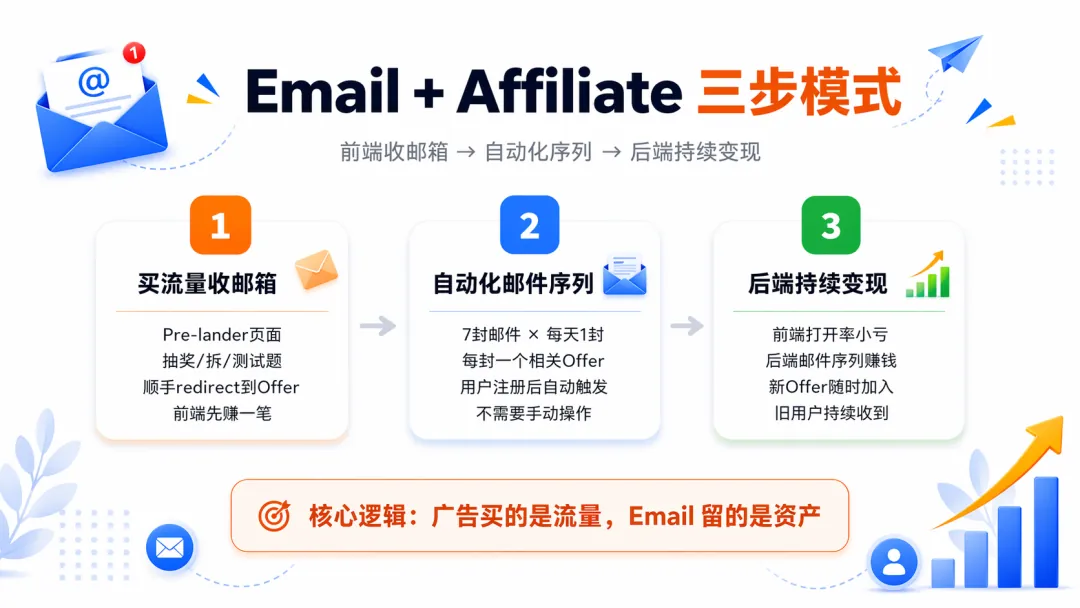
Step 1: Buy traffic, but instead of sending it to the offer, collect the email first.
Use a pre-lander—it can be a single page—that gives the user a reason to leave their email, and you can still redirect them straight to an offer at the same time.
Step 2: The email goes into the list and the automated sequence starts running.
Once the user signs up, it automatically triggers an email sequence (around 7 emails, one per day). Each email promotes a related offer.
Step 3: Keep monetizing on the back end.
The front-end traffic cost may break even or lose a little; the real money is in the back-end email sequence. And you can keep updating the offers in that sequence: add a new product today, and everyone who signed up before receives it.
Which verticals suit email
Not every category is a fit. A few of the more common directions:
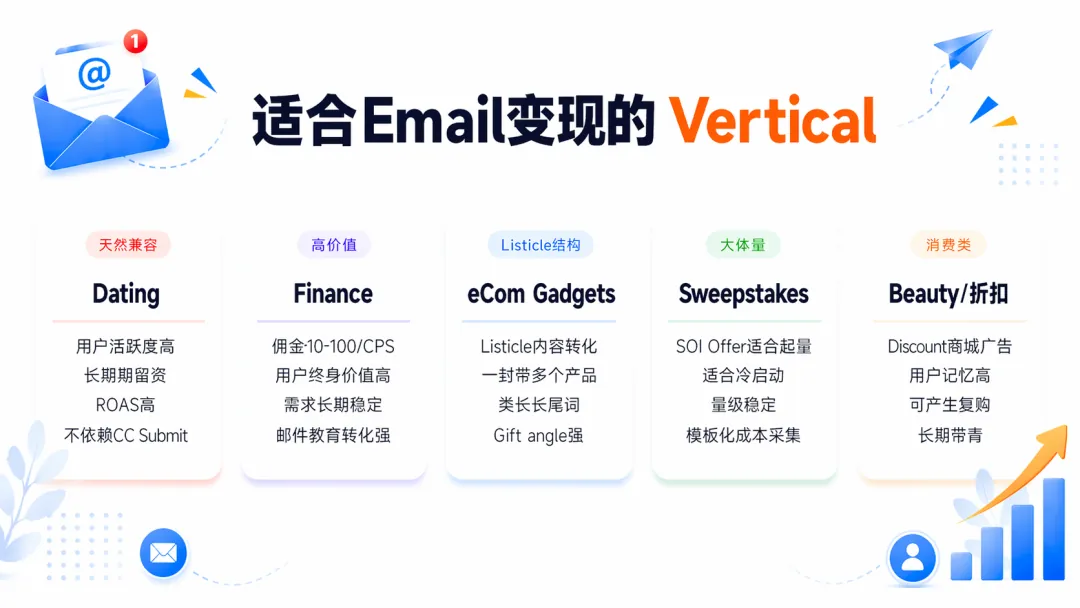
Dating: a natural repeat-purchase scenario, highly active users, the most stable long term. One caveat: only do SOI, not CC Submit, because that will wreck your sender reputation.
Finance: many people assume finance isn’t suited to email. In fact, demand from these users is long-lasting, and competition is fierce.
eCom Gadgets: send listicle content by email, with multiple product links embedded in one email; it works like a long blog post.
Sweepstakes: good for high-volume cold starts, pairing SOI offers with email.
Beauty / discounts: run it as a brand, building a Discount/Deals email brand with high user stickiness.
How to choose infrastructure?
As soon as many people hear “Email Marketing”, they assume the barrier is high: set up servers, get IPs, configure domains, fiddle with all kinds of authentication. At the start there’s really no need to make it that complicated.
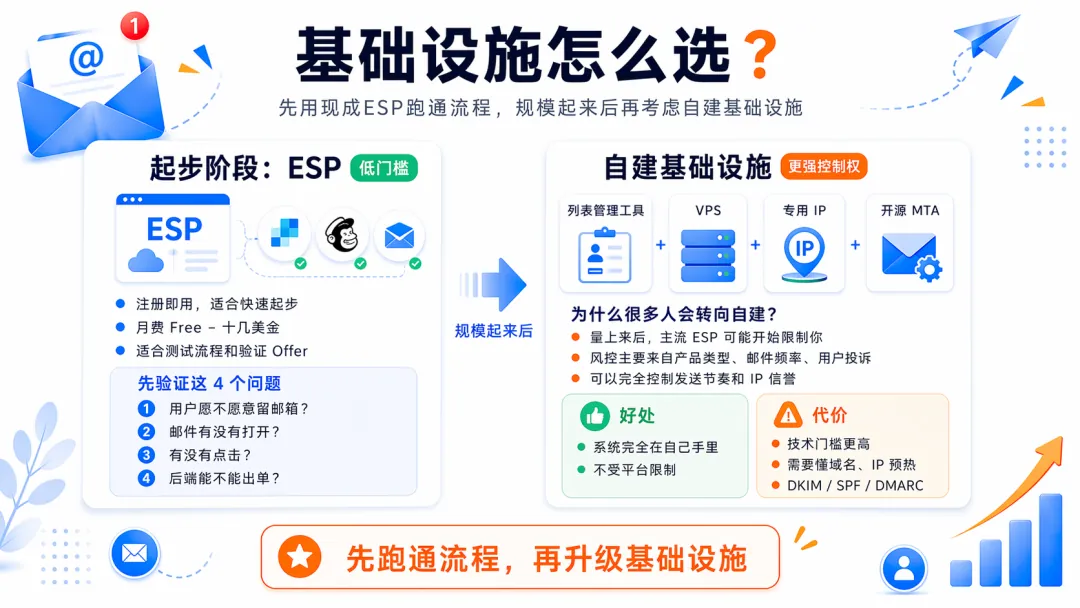
In the early stage, most people use an off-the-shelf ESP (Email Service Provider). Sign up and it’s ready to use, monthly fees range from free to a little over ten dollars, and the features are enough to test the flow and validate offers.
The point at this stage isn’t how advanced the setup is. It’s validating a few questions first:
-
Are users willing to leave their email?
-
Are the emails getting opened?
-
Are they getting clicks?
-
Does the back end produce sales?
At a certain scale, many veterans move to self-hosted infrastructure: running their own sending service, managing IP reputation, and fully controlling the sending cadence.
Because once your volume grows, many mainstream ESPs start restricting you. It mostly comes down to your product type, email frequency and user complaints; it’s part of the platform’s overall risk control.
Self-hosted: the typical stack is a list management tool on the front end and a VPS + dedicated IP + open-source MTA on the back end.
The upside of this route is that the system is completely in your hands; no platform can restrict you. The cost is a high technical barrier: you need to understand domains, IP warm-up, DKIM/SPF/DMARC and so on.
The most common traps
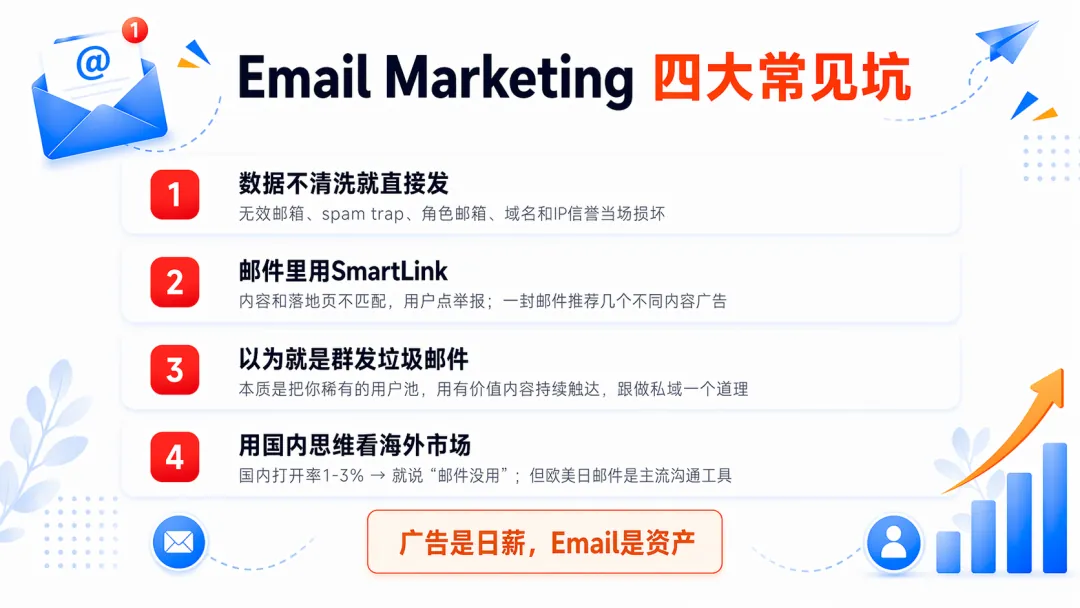
1. Not cleaning the data before you start
This is the mistake beginners make most. An uncleaned list is full of invalid addresses, spam traps and role-based emails.
There are plenty of email verification services on the market now, and they’re not expensive. This step looks like a hassle, but it’s the last cost you should cut.
2. Using SmartLinks in emails
This is also a dangerous practice. The user sees one kind of content in the email, clicks, and lands on a completely unrelated page. The experience is jarring.
The most direct consequence of that mismatch is a higher complaint rate.
3. Treating Email Marketing as mass spam
This is the biggest misconception. Email Marketing is essentially about building a user pool you own and reaching it continuously with content that has value.
It’s the same logic as private-domain traffic (an audience you own); only the channel is different.
4. Looking at overseas markets through a domestic lens
Email open rates in China are extremely low, so many people assume by default that email is useless.
Overseas is different, especially the US, Europe, Japan and Korea: email is a mainstream communication tool, and open rates are on a completely different scale from China.
If you want to test the waters, where to start
If you’re running affiliate right now and want to try the email route, the simplest way to start:
-
Add an email capture form (even just a popup) to your existing landing page, so you bank the traffic you’re already paying for
-
Find an ESP that supports automated sequences and build the simplest possible email sequence; nothing fancy, 3-5 emails is enough
-
Put the offers you’re currently running into the sequence, sent automatically one a day
-
Watch the data: open rate, click rate, unsubscribe rate. If the numbers are good, add volume; if they’re bad, work on the copy and the offer match
-
Once it works, think about upgrading tools and scaling
The key is to validate the flow first: are your users willing to leave their email? Once they do, what’s the open rate? The click rate? Once you have that data, which tools to pick and whether to self-host will sort themselves out.
One last word
The logic of media buying is that you spend money all over again every day. The logic of Email Marketing is that you put a little more away every day.
Every email you collect today could still be producing sales for you next month, next quarter.
There’s only one end goal: when you stop, the income keeps going.
Income and ROI figures here are past results of one person or case, not typical outcomes. Paid traffic can lose money; start with a small test budget.
New articles and quick notes from Peter.