 Peter Founder
What Is Affiliate Marketing? A Beginner's Guide to Earning in USD
Affiliate Marketing
Hi, I’m Peter.
I’ve covered lifetime commissions before, and traffic arbitrage too. Today let’s get a more basic question straight:
Not building a product yourself, earning commissions by promoting other people’s products: what kind of business is that, exactly?
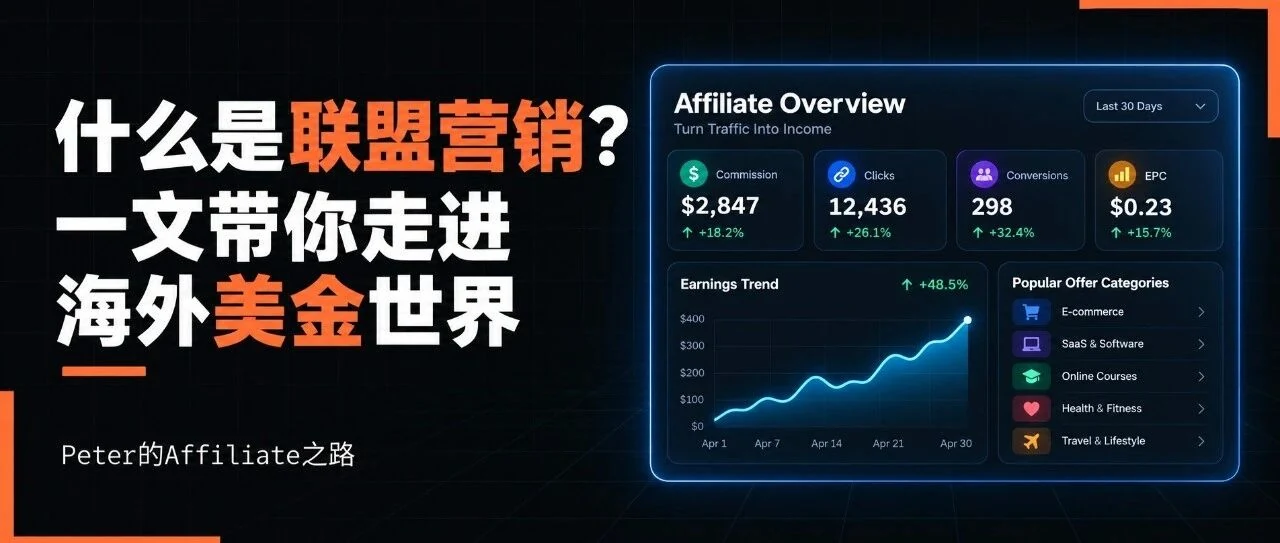
That’s affiliate marketing. You promote a merchant’s product or service, bring in the agreed results such as purchases or leads, and the merchant pays a commission according to its rules.
You can recommend software through a tutorial, do product reviews, or, like me, make paid advertising your main way of acquiring customers.
But don’t rush to sign up for platforms and apply for links. Start with the simplest possible transaction and it becomes easy to understand.
01 You don’t build the product, but you help it find customers
Say there’s a piece of software that sells for $100.
Its affiliate program says: bring in one qualifying order and you get a 20% commission.
After actually using it, you write a tutorial that explains what problem it solves, who it suits, who it doesn’t, and you include your affiliate link.
A reader buys through the link, the order is correctly attributed to you and passes review, and you get:
$100 × 20% = $20 commission.
That’s affiliate marketing at its simplest.
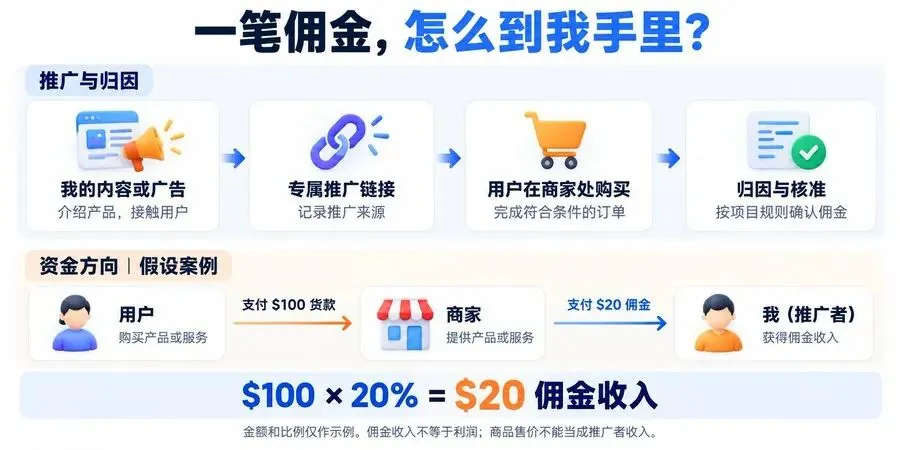
In this example, you didn’t develop the software, and the $100 isn’t your actual income.
You took part in the promotion stage, and what you get is the $20 commission. Only after subtracting what the promotion cost you do you have a profit.
So why is the merchant willing to pay?
From the merchant’s point of view, building a product doesn’t mean customers will show up on their own.
If, after evaluating, it decides that $20 for a new customer is worth it, then that commission is the acquisition cost it’s willing to bear.
The merchant supplies the product; you bring the right people.
The merchant isn’t handing you money for nothing; you took part in its sales process.
In the real world, Amazon Associates works exactly this way: creators, site owners and bloggers recommend products with affiliate links and earn commissions from qualifying purchases or other program actions.
So you don’t have to start out thinking about what product to develop.
You can ask yourself first: which product can I help find customers?
02 How do you prove the customer came from you?
Through tracking and attribution.
Your unique affiliate link usually carries your identifier. When a user clicks, the system records the source, then, according to the program rules, ties qualifying orders or actions to you. Once the commission is approved, it goes into the payout process.
Broken down, it’s:
Your content or ad → affiliate link → user completes the agreed action → system attributes it → commission approved → payout.
But there’s a common misunderstanding here:
He clicked my link, so whatever he buys from now on counts as mine.
Not necessarily.
Programs set an attribution window and conditions. Past the window, another channel involved in the sale, a cancelled order: any of these can affect the commission you finally receive. A pending-review entry in the dashboard doesn’t mean that money is withdrawable yet.
So when you look at a program, don’t just look at the “up to X% commission” on the promo page.
Care more about: what counts as commissionable, how attribution is confirmed, what gets cancelled, and when payouts happen.
The commission rate decides how much one sale pays.
Attribution and payout rules decide whether you get it at all.
03 Commissions aren’t only one sale, one payment
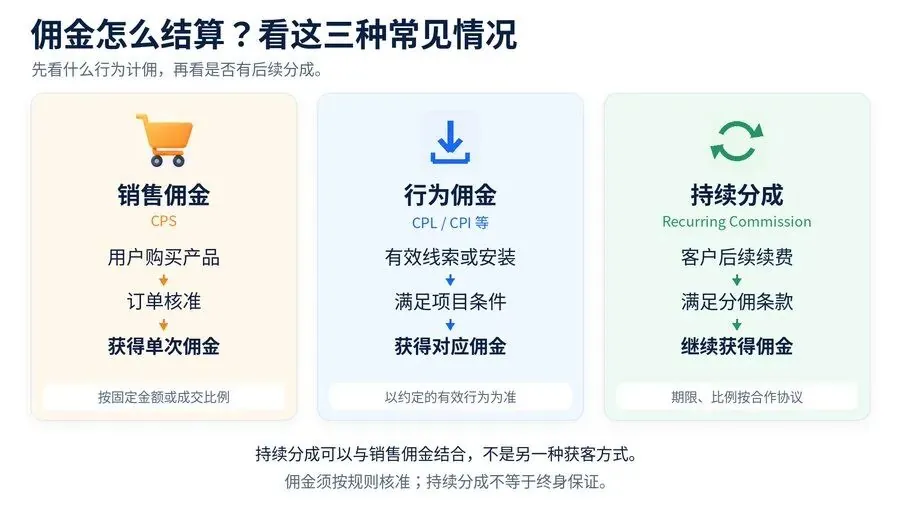
First, get to know three common cases.
Type 1: Sales commission
The user completes a qualifying purchase, and you get a fixed amount or a share of the order value.
The earlier example, a $100 order with 20% commission, is paid on sales. The common abbreviation is CPS.
Type 2: Commission for a valid action
It doesn’t have to be a product sale; merchants may also pay for valid leads or installs.
For example, a user submitting a qualifying inquiry form is the common CPL, paid per valid lead; qualifying app installs brought in through promotion may use CPI, paid per install.
The key here isn’t that a form was filled in or a download happened, but whether the program’s validity conditions were met.
If the program wants valid customers, you can’t pass off randomly filled-in details as valid leads.
Type 3: Recurring revenue share
After the first sale, if the customer keeps paying, you may also earn follow-on commissions under the rules.
For example, HubSpot’s officially listed entry tier is 30% recurring commission for up to one year. It doesn’t pay only on the first sale, but it isn’t an indefinite share either.
That’s why, when I talked about lifetime commissions earlier, what I really wanted people to understand was the logic behind it:
Only if the product you recommend is one the customer is willing to keep using can the program keep sharing part of the later revenue with you.
That said, which action gets paid and how long the share lasts are two separate dimensions. A sales commission can also come with a renewal share; they aren’t mutually exclusive plays.
04 Can you do it without a big following?
Follower count alone can’t answer that.
First think about: how do you plan to reach users?
There are two common paths: one through content, one through paid advertising. Content can carry affiliate links; paid promotion requires confirming which channels and methods the program allows.
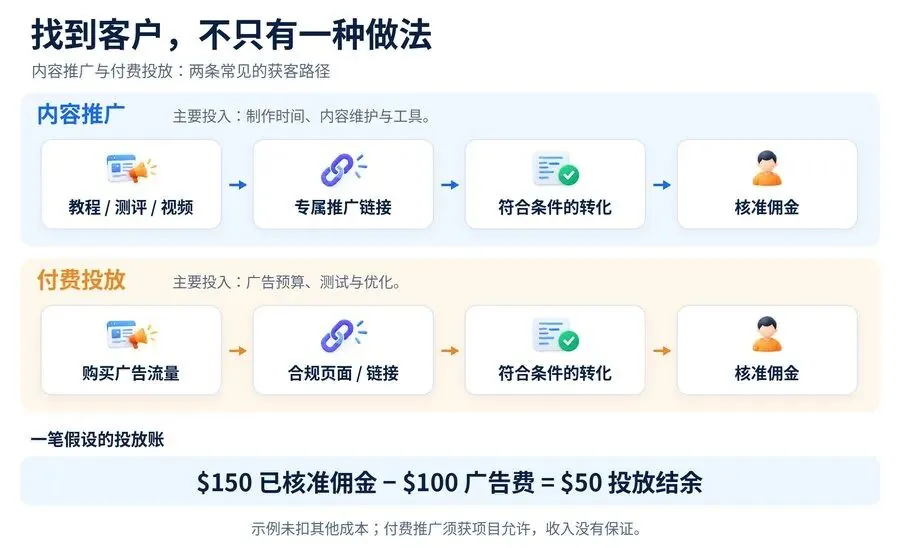
One path: content promotion
Say you know website builders well.
Rather than a one-liner like “this tool is great, sign up now”, people would much rather see a concrete tutorial:
How does someone who can’t code at all use it to build their first website? How much does it cost? What are the limits? When shouldn’t you buy it?
You solve the reader’s problem first, then let them judge whether the tool suits them.
At that point the affiliate link is part of the content, not the only reason the content exists.
I prefer to think of the investment in content promotion as: learning the product, actually testing it, writing and producing, and ongoing maintenance.
Just because you didn’t buy ads directly doesn’t make your time free.
The other path: paid promotion
My work is closer to this one: pick a vertical, prepare creatives and pages, buy ad traffic, then see how many valid conversions that traffic produces.
Say you spend $100 on ads and end up with 10 approved conversions at $15 commission each.
Then:
Commission income: 10 × 15 = $150.
Minus ad spend: 150 - 100 = $50.
That $50 is what’s left from the campaign, before tools and other operating costs.
But if you spend the same $100 and end up with only 4 approved conversions:
4 × 15 - 100 = a $40 loss.
Which is my point:
A high commission doesn’t mean it’s easy.
Commission, conversion rate and acquisition cost have to be looked at together.
Getting an affiliate link doesn’t mean you can advertise however you like either. Some programs restrict brand bidding, direct linking in ads or certain traffic sources. Read the rules before you launch.
05 How is it different from traffic arbitrage and sponsored work?
I like to separate them by the question each one asks.
Affiliate marketing asks: who am I promoting for, what result do I bring, and how much commission do they pay me?
Traffic arbitrage asks: can the traffic I paid for be monetized for more than it cost?
When you buy traffic to promote affiliate products, the two overlap.
But earning sales commissions from organic visits to a tutorial is affiliate marketing too, and it doesn’t necessarily involve buying traffic.
So don’t reduce affiliate to just running ads.
As for sponsored work, I first look at what the contract pays for.
If a brand pays me a flat fee to write an article, that fee mainly covers content production and publishing.
If the deal is a commission per approved order, my income depends on actual results.
The same deal can also be flat fee + commission. For me, what matters isn’t the label, but what work and risk I take on, and on what terms I get paid.
06 Where do you find products to promote?
You don’t need to memorize dozens of platforms right away.
First, tell two kinds of entry points apart.
One kind: the merchant’s own affiliate program
For example Amazon Associates, and the Shopify Affiliate Program aimed at content creators, educators and similar groups. You apply to a specific merchant’s program, and the program sets the entry requirements and commission rules.
The other kind: affiliate networks
For example Awin, which connects merchants with affiliates and provides tracking, account management and payouts. One network can host many merchants’ programs.
For beginners, I’d suggest searching the other way round:
First find a product you know and genuinely want to recommend, then check whether it has a suitable affiliate program.
Not: see a high commission first, then scramble for reasons why the product is good.
If the product and the audience don’t match, no commission rate is high enough to make it work.
Note that what this article is really about is: can you take your content, your expertise or your customer-acquisition skills and put them to use in a bigger market?
07 What should an ordinary person do first?
My advice: complete one real, valid recommendation first.
Pick a product you know
Without looking at the sales page, can you explain what problem it solves? What its drawbacks are? Which users it suits?
Then read the program rules properly
Confirm the commission conditions, attribution window, permitted promotion methods, payout cycle and payment requirements. These are also what you check when evaluating any affiliate program.
Next, make a piece of content that actually helps
It can be a tutorial, a hands-on review, or a walkthrough of solving one specific problem. The standard is simple:
Even if the reader never clicks the affiliate link, the content should still be useful to them.
After publishing, watch whether there are clicks, whether there are qualifying conversions, whether the commission gets approved, and whether you finally receive it.
Once that chain works end to end, think about adding content or budget.
When promoting, be upfront about the relationship too. For example: “If you buy through this link, I may earn a commission.” Readers won’t mind that much.
I don’t think earning a commission and helping people are inherently at odds.
But I do ask myself one question:
If this product paid no commission, would I still recommend it?
At the very least, it reminds me not to let the commission make the decision for me.
08 A few thoughts: AI can help, but you have to understand the business yourself
I use AI and automation tools in my ad work.
For me, the most important thing to understand about affiliate marketing is:
You don’t have to own a product before you can take part in a business.
You can first learn to understand demand, explain the right product clearly, and then earn income from real promotion results.
But money doesn’t suddenly become easy to earn just because it’s in dollars.
A link isn’t a business. Whether you can keep finding the right people, give them useful information, and keep a clear account of costs and income: that’s the skill worth practicing.
Help one person make the right choice first, then earn your first commission that has a basis and actually gets paid out.
That’s closer to a real start than bookmarking a hundred dollar-earning programs at once.
I hope this article helps you understand affiliate marketing abroad and opens up your thinking. Enjoy!
New articles and quick notes from Peter.