 Peter Founder
Hong Kong Company vs. UK Company: Affiliates vs. Indie Developers

This article is based solely on my own registration experience. It is not tax or legal advice; please consult a professional about your own situation.
After I got back from Hong Kong, quite a few people messaged me privately asking me to write an article about Hong Kong companies.
And some of them asked: “Why not a UK company? Everyone online says UK companies are cheap and easy to get Stripe with.”
So today let’s take this question apart properly.
1. Two completely different tracks
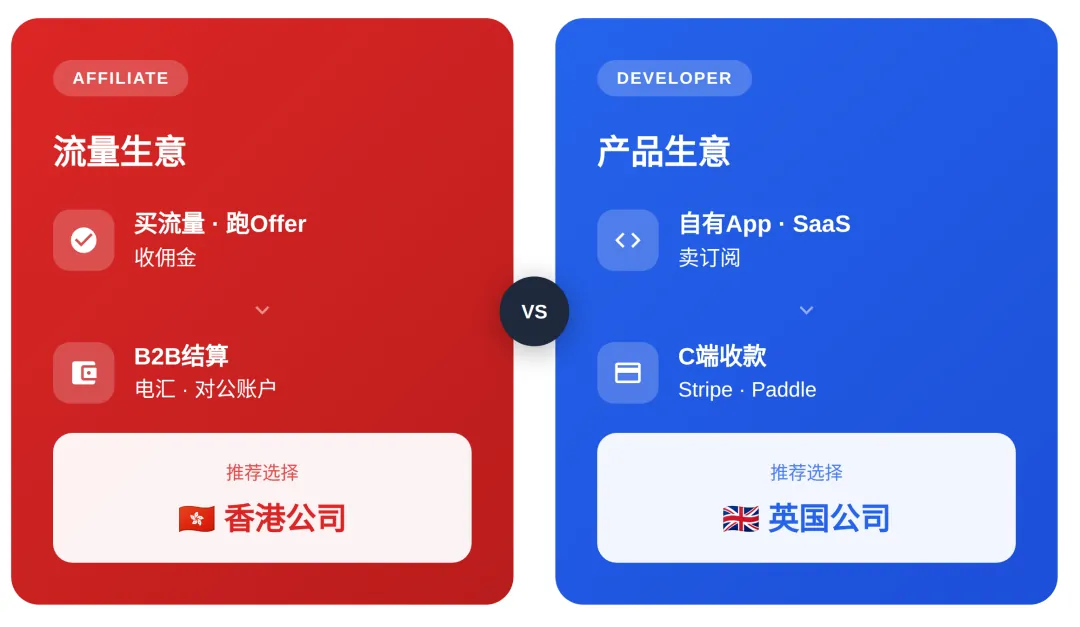
First, a premise a lot of people overlook: affiliates and indie developers are both doing business overseas, but they make money in completely different ways.
Affiliates are in the traffic business: buy traffic, run offers, collect commissions. Money comes in from the network and then goes out to top up ad platforms. At its core it’s B2B settlement, running on wire transfers and business bank accounts.
Indie developers are in the product business: their own apps, SaaS, subscriptions. Money comes from the credit cards of users all over the world and is collected through payment platforms like Stripe and Paddle. At its core it’s consumer payments, running on online payment channels.
So the way you get paid determines which company entity you choose. That’s not to say a UK company can’t be registered; it’s just that based on my own experience as an affiliate, plus the distance cost I mentioned in an earlier post, a Hong Kong company comes first.
2. UK company: the indie developer standard
Why are UK companies so popular in indie developer circles?
The reason is simple: Stripe is extremely friendly to UK companies.
Stripe isn’t directly open to individuals in mainland China, so many indie developers register through an overseas entity, and the UK is one of the most common and most mature choices.
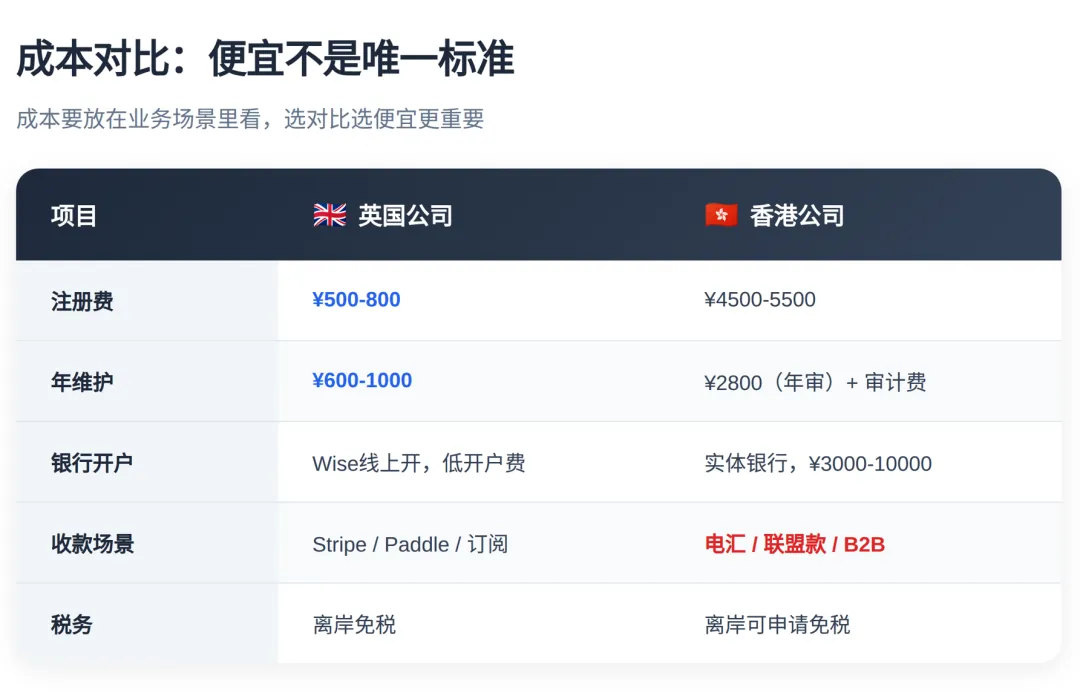
Register a UK company, pair it with a Wise business account, and a Stripe application usually goes through in ten-odd minutes; at the latest you’ll get the email in 1-2 days. No flying over, no in-person interview, the whole thing done online.
The cost is absurdly low too (I hear prices have gone up recently). Most people used to register through an agent like 1st Formations for a total of just a few dozen GBP, and the annual upkeep (address renewal plus tax filing) might add up to under $200.
In the past couple of years, more people register directly on the official site, buy a registered address from a Taobao agent, and file the taxes themselves.
The most important point: you can apply for an exemption on offshore income. That’s why so many indie developers favor it.
3. Hong Kong company: home base for more affiliates
But if you’re an affiliate, things are a little different from indie developers.
Networks pay your business account through online banks like Wise, Paxum, PayPal and Payoneer, not through Stripe’s online payment channel.
That said, a Hong Kong company can also apply for a Stripe Hong Kong account; the process is just a bit more involved than in the UK. If an affiliate wants to build their own product down the line, a Hong Kong company isn’t a dead end.
One more thing: an affiliate’s money flows both ways. Network payments come in and immediately go out to fund traffic platforms. Those who pick a brick-and-mortar bank in Hong Kong value its security and staying power, which virtual banks can’t match.
4. Both?
Some people ask: can I register both?
You can, but there’s no need.
If you’re just starting out and volume is small, a UK company works fine. Wise can also issue virtual cards, which makes topping up ad spend and paying for tool subscriptions pretty convenient.
But once volume picks up, with thousands to tens of thousands of US dollars moving in and out every month, I’d go straight to a Hong Kong company plus a physical bank. The channel is stable, problems can be solved in person, and you save yourself from doing it all over again later.
Unless you’re running affiliate and a SaaS product at the same time and need to keep the two cash flows separate, every extra company means extra maintenance cost and extra energy drain.
Wait until the business is genuinely complex enough to need two entities. Don’t build a big structure before you’ve made any money.
5. Final thoughts
“Where should I register my company?” is really a question about what your business model is and what stage you’re at.
Just starting out with a limited budget: a UK company is a low-cost starting point.
Business validated and scaling: a Hong Kong company plus a physical bank is the more solid choice.
I hope this article gives you some ideas.
New articles and quick notes from Peter.