 Peter Founder
Affiliate Marketing in 2026: How It Makes Money, in 3 Minutes

Last week a friend who runs an independent e-commerce store asked me: this Affiliate thing you talk about every day, what is it actually? Is it the same as being a Taobao affiliate?
After ten years in it, I’d forgotten how foreign this business is to people outside the circle.
So today’s post is written specifically for those who’ve heard of it but never done it. I’ll try to use plain language and explain it in three minutes: what Affiliate Marketing actually is, where the money comes from, and whether an ordinary person can do it.
It’s sales: you help others sell, and take a cut when it sells
It’s that simple.
You don’t need your own product, you don’t deal with a supply chain, you don’t handle after-sales. You do one thing: send traffic to the advertiser’s page, and when the user completes a specified action (sign up, download, pay), you get a commission.
That “specified action” is what the industry calls a Conversion. There are a few commission models:
- CPA (Cost Per Action): the user completes an action and you get a fixed commission. For example, $3 for one account registration
- CPS (Cost Per Sale): the user buys something and you get a percentage of the sale. Amazon Associates, for example, pays 3%-10%
- CPL (Cost Per Lead): the user fills in a form and you get paid. Common with insurance and loan offers
Sounds like Taobao affiliate? The logic is indeed the same. But Affiliate Marketing is a global business: the market is far bigger, and the plays are far wilder.
How the chain fits together
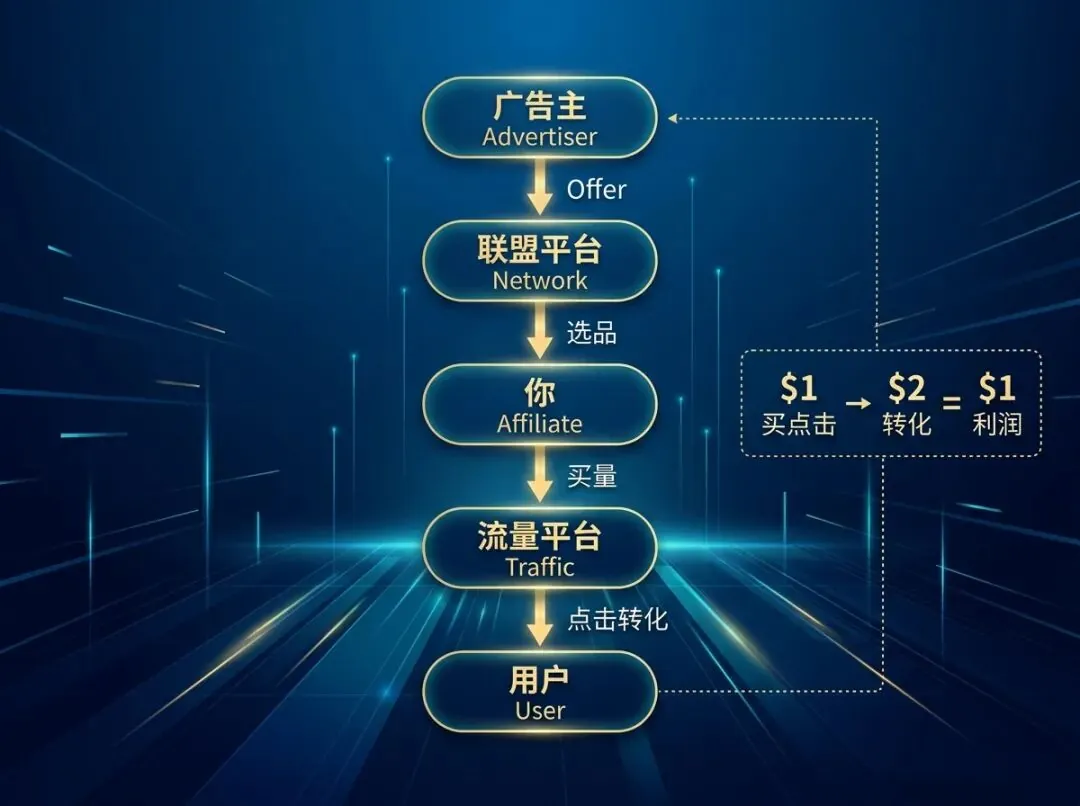
Many newcomers can’t tell the roles apart, so here’s a simple chain:
Advertiser → has a product to promote, say a utility app, a mobile game or an e-commerce platform
Affiliate Network → the middleman. It pools offers from a pile of advertisers and gives you a dashboard to pick from. Common ones include Monetizer, Clickdealer and Zeydoo
You (Affiliate / Publisher) → pick an offer from the network, then go buy traffic to promote it
Traffic Source → where you spend money to buy traffic. Facebook, Google and TikTok are one kind; Push/Pop ad platforms like PropellerAds and RichPush are another
User → sees your ad, clicks, completes the action, and you make money
Put bluntly, you’re a traffic middleman earning the spread. You pay $1 for a click, that click brings a $2 Conversion, and you’ve made $1.
That spread is the Affiliate’s profit. In industry jargon it’s ROI (return on investment). An ROI of 100% means you put in $1 and earn $1.
The Affiliate earning path

You may have seen those screenshots online of $100,000 a month, the same way everyone online supposedly earns over 10,000 a month. Let me say something realistic:
Beginner stage (0-6 months):
You’ll almost certainly lose money. Don’t panic, that’s tuition. You’re learning how to pick offers, build landing pages, set up a tracker, optimize ads, and every one of those skills takes time.
When I got into the industry in 2016, I lost close to $3,000 in the first six months. I was running Domain traffic + Sweeps offers back then, staring at the tracker dashboard every day, days and nights flipped.
Intermediate stage (6-18 months):
You’ve found a method and can run profitable campaigns. Maybe $10-$100 profit a day. Not much, but it shows you’ve grasped the methodology. The key now is scaling: expanding one profitable campaign to more GEOs (countries) and more traffic sources.
Mature stage (2 years+):
You have your own playbook, you know which verticals suit you, you have stable relationships with affiliate managers, and you may even start automating with tools and AI. $100-$1,000 profit a day isn’t a fairy tale, but only a minority get there.
Want in? Here’s what you need to prepare
OK, if you’ve read this far without closing the page, you’re genuinely interested. So let me talk about what you actually need.
Starting capital
A minimum of $1,000-$5,000. That’s not money for buying courses, it’s real cash to spend on ad testing.
Don’t believe the “zero-cost Affiliate” talk. Free SEO traffic works in theory, but the cycle is too long; for a beginner the feedback is too slow, and people quit before the feedback ever arrives.
I suggest starting with Push or Pop traffic: low barrier, loose review, fast data feedback. $500 is enough to test a dozen or so campaigns, enough to find out whether you have a feel for this business.
Essential tool list
-
Tracker: this is your data hub. No tracker means throwing darts blindfolded. I recommend BeMob (it has a free plan)
-
Affiliate Network accounts: sign up with at least 2 networks. Beginner-friendly ones include Monetizer and Zeydoo
-
Traffic source account: start with one platform. For Pop/Push traffic I recommend PropellerAds or RollerAds, low barrier to entry
-
Landing Page: you need to be able to build a simple landing page. No coding needed, just modify a template
-
A VPS or hosting: to host your landing page and tracker. Free Cloudflare Pages is enough
-
Spy tools (optional): Anstrex or AdPlexity, for seeing what ads other people are running. Expensive, but not something to skimp on.
Core skills
You don’t need to know how to program, but you do need to learn:
- Reading and analyzing data
- The ability to work with AI (editing landing pages)
- English reading ability (most resources are in English)
- Patience. This one matters most; it’s what carried me all the way here
Can you still do this in 2026?

This is the question I get asked most.
The answer: yes, but it’s completely different from a few years ago.
What changed?
Traffic keeps getting more expensive. Facebook’s CPM has nearly doubled from 2020 to now. Google too. The era of brute-force Media Buying alone really is over.
AI has changed the rules of the game. That’s not a cliche; I’m the example. I now use Claude Code to write landing pages, AI to generate ad creatives, and automated skills to manage campaigns. That’s the trend, and you have no choice but to keep up.
Compliance demands are higher. Many gray-area offers that used to run are now policed strictly. On the flip side, the competitive environment for legitimate offers is fairer too. Running e-commerce offers, for example
My take: the bar is rising, but so is the ceiling. An Affiliate who can use AI tools is 2-5 times as efficient as a traditional player. That’s not an exaggeration, it’s my own experience.
The biggest advantage of entering Affiliate in 2026 isn’t some traffic bonanza; it’s that AI tools let one person do the work of 3-5 people.
The 3 traps beginners fall into most
I’ve fallen into every one of them:
Trap one: starting with Facebook. FB reviews are strict, bans are fast, and accounts need warming up; for a beginner this is an easy way to crush your confidence. Start with Push/Pop traffic, and touch FB only once you understand the whole chain.
Trap two: testing too many things at once. Weight loss today, Dating tomorrow, Sweeps the day after, a shallow taste of each and you learn nothing. Pick one vertical and run it for at least a month before deciding whether to switch.
Trap three: starting without a tracker. I’ve seen people paste the affiliate link straight into the ad and run it. Brother, without data how do you know which landing page is better, which GEO makes money, which hours convert best? The tracker has to be set up on day one.
Where a beginner starts
If you really want to give it a try, start here:
-
Sign up with an Affiliate Network: apply on the Zeydoo or Clickdealer website, and say in the application that you have a budget for testing (no experience? don’t panic, just submit the form and be sincere). If you’re rejected, try another one (you can ask me for help), and apply to several.
-
Register a free BeMob account: this is your tracker. Sign up first and get familiar with the dashboard.
-
Register with a traffic source: PropellerAds. Deposit $100, no rush to spend it, first see what the dashboard looks like, and hook up the postback before you start running.
-
Take a stroll around the Afflift forum: read other people’s Follow Alongs (hands-on campaign diaries) to get a feel for the real process
Every day people enter this industry, and people leave it.
The AI era is an opportunity for every industry; otherwise why would so many people choose to go global right now?
But having AI doesn’t mean you can keep going. To put it realistically:
Put some budget into testing + spend three months learning and making mistakes. If it fits, stay.
Income and ROI figures here are past results of one person or case, not typical outcomes. Paid traffic can lose money; start with a small test budget.
New articles and quick notes from Peter.