 Peter Founder
MVAS: Evergreen Vertical, So Why Do Beginners Always Lose Money?
MVAS
Hi, I’m Peter.
Anyone in our industry has heard the name MVAS at some point.
It may be one of the oldest verticals in the entire affiliate industry: it has survived all the way from the ringback-tone era to today, and there have always been people quietly making money in it.
But it has another identity too: a regular on the list of things beginners lose money on. And unlike other verticals, the traps aren’t on the traffic side. They’re in places you can’t see.
This is going to be a long one, so I can cover it all in one go: what it is, how each market plays it, how money leaks out along the chain, and the mainstream way to enter in 2025 and 2026: PIN API.
Quick overview
- MVAS = a subscription business billed to the phone bill, usually run in Southeast Asia, the Middle East and Africa
- Settlement chain: carrier → aggregator → affiliate network, with caps, KPIs and holds at every layer
- The mainstream play for 2026, PIN API: both the phone-number entry and the verification code happen on your own page
- How to start testing: established platforms + small daily-paid runs to verify the money actually arrives
01 What MVAS actually is
MVAS (mobile value-added services), in plain language, means “subscription services billed to your phone credit”: light content like game portals, video bundles and horoscopes. After the user subscribes, the fee doesn’t go through a credit card or an e-wallet. It’s charged straight to the phone bill, deducted by the carrier, and renewed automatically daily or weekly.
In industry jargon this billing method is called DCB, direct carrier billing.

MVAS: the business of putting subscription fees straight on the phone bill
This isn’t new.
Twenty years ago it sold ringback tones, wallpapers and horoscope SMS. Later, one-off purchases turned into micro-subscriptions and the content became games, video and sports bundles, but the skeleton never changed: the carrier collects, and it renews every cycle.
Its home turf is markets with low credit-card penetration and mostly prepaid users: MENA, Southeast Asia, Latin America, Africa.
In those places, phone credit is the one “payment account” everyone has. Nigeria, Indonesia, Kenya, South Africa: these GEOs are exactly its territory.
02 Every market speaks its own dialect
MVAS has a feature many beginners don’t know about: the way a subscription gets confirmed (the “flow”, in industry jargon) isn’t standardized globally. It’s different in every GEO, roughly like this:
| Region | Main flow | In one line |
|---|---|---|
| Most of Africa | 1-click / 2-click | On the carrier network the number is detected automatically; one or two taps and you're subscribed |
| Kenya | USSD | A Safaricom specialty: dial a code to confirm |
| Asia / Eastern Europe | Click2SMS (MO/MT) | Opens the SMS app and sends a pre-filled text message to subscribe |
| MENA | PIN submit / HE | Enter the number, then enter the SMS verification code; the mainstream option for Wi-Fi scenarios |
| Cross-GEO trend | PIN API | The page is yours; the verification code is sent and received through your own API |
So before picking an offer, check which flow the GEO uses. It directly determines how you build your LP, how you shoot creatives, and how many steps the user has to take.
Throwing one set of assets at everything won’t last long in this vertical.
03 What beginners need to learn before they buy traffic
Sometimes the barrier in MVAS isn’t the media buying. It’s understanding how the money comes back. Read on and you’ll see what I mean.
The money deducted from the user’s phone credit passes through several hands before it gets to you:

Every layer in the chain decides how much you end up with
- The carrier sets the rules: daily/monthly caps, LP approval, GEO regulation. One new regulation can shut a line down overnight;
- The aggregator and the network each take a cut, and each has its own KPIs. If your unsubscribe rate or complaint rate misses the mark, your volume gets cut;
- Holds, chargebacks and differing settlement definitions all happen where you can’t see them. The conversion count in the dashboard isn’t the money that lands in your account. Shaving can happen too.
Let me expand on KPIs, because that’s what beginners most often overlook.
Your upstream advertiser has to answer to the carrier for complaint and unsubscribe rates, and the carrier has to answer to the regulator for user complaints.
If any link exceeds the limit, it’s not just your volume that gets cut. It could be the entire product line.
So you’ll run into a very frustrating situation: your creatives are fine, conversions are decent, and your volume suddenly gets stopped, because someone else on the same line was messing around and you took the hit.
Stack on caps, hold periods and invisible shaving, and the offer’s budget may be gone before your test even has a chance to fail.
When beginners fall flat, it’s mostly not because the LP is bad. It’s because they underestimated how tightly controlled this chain is.
04 How the playbook evolved
MVAS flows have always shifted with regulation.
The earliest 1-click and 2-click flows: on the carrier network, the user tapped once or twice and was subscribed. Conversion was frighteningly high, and so was the chaos. “When did I subscribe to this?” complaints were everywhere, regulators in every country did a round of cleanup, and second confirmation became mandatory.
In between, local variants like click2SMS, USSD and IVR evolved, and then PIN submit became the mainstream in most of the market: the user enters a phone number, receives an SMS verification code, and enters it to confirm.
In essence, it turned second confirmation into a standard action: the user receives the code and enters it themselves, so it’s hard to dispute.
By this stage, MVAS was already much cleaner than in the early years.
But for affiliates there was still an awkward part: the two most critical actions, entering the number and entering the code, happen on a landing page provided by the network or the direct advertiser. What the page looks like, where users drop off, how many drop off: you only get a rough idea. Hence the next step.
05 The 2025 and 2026 mainstream: PIN API
PIN API solves exactly one question, “who owns the page”:
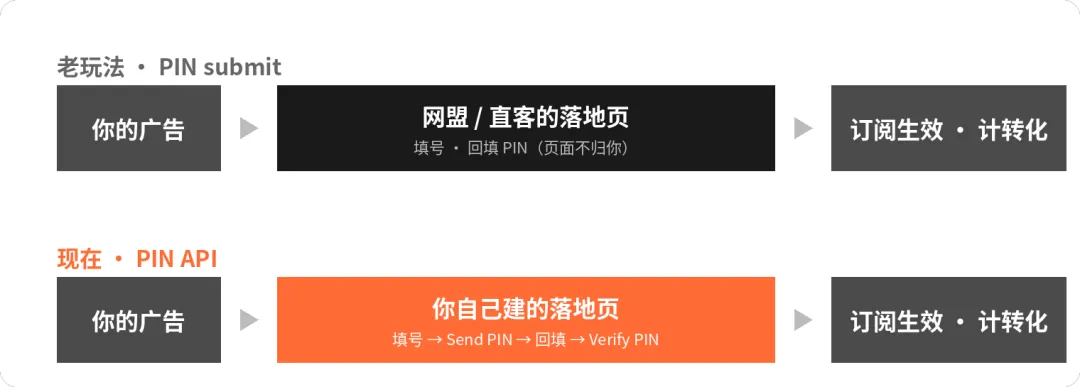
PIN submit to PIN API: what changes isn’t the user’s action, it’s who owns the page
In practice, your LP looks roughly like this: collect the number on the left, enter the verification code on the right:
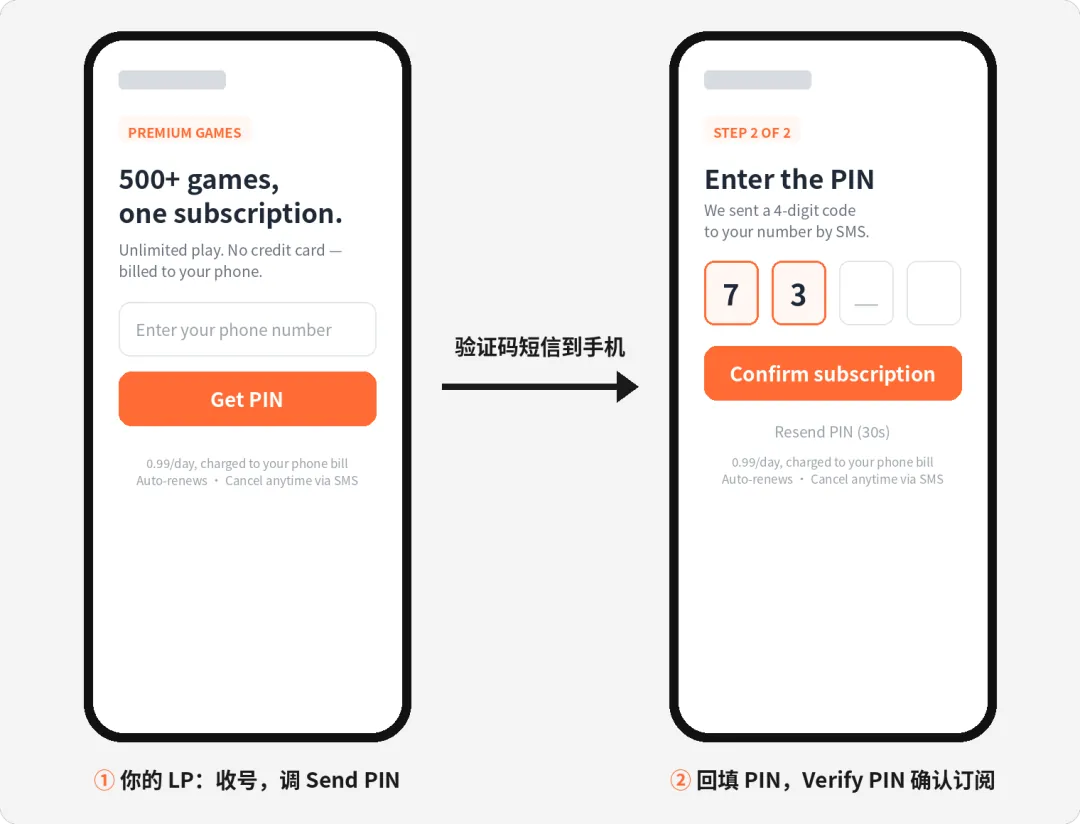
A standard PIN API subscription flow (illustration)
The three things you actually have to do
First, build your own landing page. Everything from the hero image to the button copy is under your control;
Second, integrate two API calls. When the user enters a number, you call Send PIN to send the verification code; when the user enters the code, you call Verify PIN to validate it. If it passes, the subscription is active and one conversion is counted;
Third, fire every step’s event into your own tracker, and look at number-entry rate, code-entry rate and settlement rate separately.
The benefits and the costs are both out in the open
The benefits: you can test every element on the page yourself (unthinkable with the old PIN submit), all the funnel data is in your hands, and reconciling with upstream is clear. You know how many PINs you sent and how many verified, and nobody can fool anybody.
For those of us who like to turn everything into data, that’s a qualitative change.
The costs: you have to be able to build a site and integrate APIs, and every step of the conversion funnel is now your responsibility, compliance included.
Pricing, terms and how to unsubscribe have to be displayed according to the carrier’s rules, out in the open, as in the illustration above.
06 If you want to test in 2026, what’s step one
Step one isn’t buying traffic. It’s picking a partner.
Look for the established platforms that specialize in MVAS: Golden Goose, Traffic Company, Mobplus, Mobidea and so on.
For example: their blogs are the best free textbooks for this vertical.
Daily payouts are standard in this industry, so use them: run small first, watch the real payments arrive, and until the first payment lands, don’t listen to any promises.
For pacing, lock in one GEO and one carrier first, get real numbers for your own little funnel of “number-entry rate × code-entry rate × settlement rate”, and only then talk about a second market.
When picking a GEO, don’t just look at the highest number on the payout sheet. High payouts usually come with the toughest KPIs and the longest holds.
On the traffic side, pop and push are the cheapest place to start; move on to other sources once things are running smoothly.
The last point matters most: the advertiser never looks at your CR. They look at subscription retention. If users stay and unsubscribes are low, your volume is worth something, and only then are you in a position to negotiate a higher payout or exclusives.
07 My take
MVAS is: low unit price, high volume. It’s not a contest of one creative; it’s about the systemic efficiency of the entire chain.
That’s also why beginners fall into traps: treating it like a simple offer, running one round of tests and then deciding stop/go, no longer works.
But the PIN API form is actually the most affiliate-friendly change MVAS has seen in years.
Landing page, verification API, data postback: all inside your own system. That’s exactly the form best suited to automation. Readers with technical skills have never had a bigger edge in this vertical than they do now.
New articles and quick notes from Peter.