 Peter Founder
Wise Business Account 90-Day Rule: What It Means for Affiliates

Wise Business Account
Hi, I’m Peter.
I count as a long-time Wise user, from the days when it was still called TransferWise right up to now. I hold two business accounts and one personal account.
In my view it has always been a platform that’s friendly to freelancers and to receiving cross-border payments.
This change targets Hong Kong business accounts. Let me lay out what happened, and while I’m at it, talk about how I think business accounts should be set up.
Note: this article is a compilation of personal experience and public information. For licensing details, refer to each platform’s official website and the regulators’ registers; for terms, refer to each platform’s latest agreement. Nothing here is financial, legal or investment advice.
01 What changed
Just now, Wise sent a notice to Hong Kong business account users: Section 12.1(b) of the Business Account Customer Agreement has been amended, and it applies to all Wise business accounts whose holders are in Hong Kong.
Continuing to use Wise counts as accepting the updated terms.
The gist of the new wording:
A Wise account is not a bank account and not a stored-value tool. After funds arrive in the account, they need to be withdrawn or used for a subsequent purpose within 90 calendar days (transfers and currency conversion both count).
If the deadline passes with nothing done, or if the account is used like a bank or a stored-value tool, Wise may force-withdraw all funds in the account, with transfer fees and exchange rates calculated according to its pricing page. In serious cases the account may be suspended or deactivated. (Paraphrased; the official wording of the terms prevails.)
Below is the original notice that arrived by email:
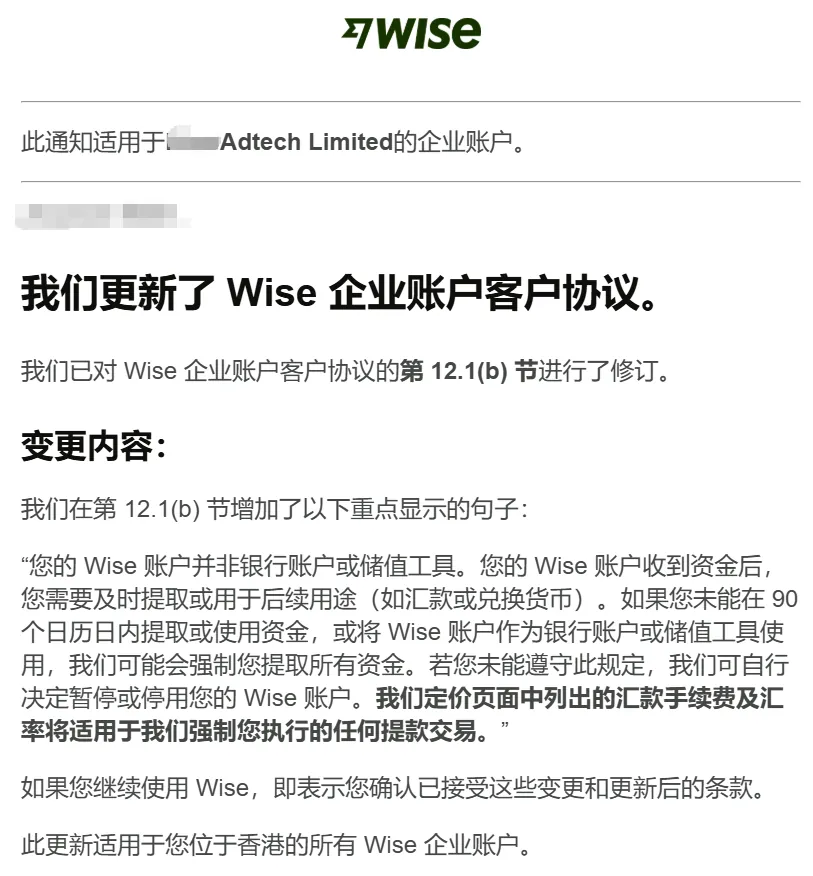
Wise’s agreement update notice, applying to all Hong Kong business accounts
In one sentence: from now on Wise only lets money pass through; it doesn’t let money live there.
One more point that’s easy to misread: even if the account has money moving in and out every month, as long as one incoming sum sits for 90 days without being withdrawn or converted, that portion falls under the new rule.
My own account is exactly that case: monthly activity, but one balance that has sat untouched for a long time. Precisely the profile the new rule is aimed at.
02 What it actually means for affiliates
First, why this update is worth your attention: Wise is the payment-collection tool many affiliates use.
You can open a Wise account online, receiving USD wire transfers from the various networks is fairly convenient, and once the payout lands, converting and transferring are fast too.
The fees aren’t what you’d call cheap, but it genuinely solves the payment-collection problem for a lot of people, especially community members who live far from Hong Kong. Making a special trip to Hong Kong just to open an account, with flights, hotel and time off work, costs far more than the fees.
An account you can sort out entirely online is already the best option for most people.
For people who only use Wise as a pass-through channel for funds, the new rule’s impact is relatively limited. The ones who really need to adjust are those who treat Wise as their main business account, or even park balances there long term.
03 Virtual + brick-and-mortar business accounts: the 2+2 setup
This is what the terms update is really reminding us of.
Online accounts are quick to open and convenient for payouts, but this time we’ve also seen the other side: when the terms change, you have to act.
Today it’s the 90-day rule; tomorrow it could be something else. Add the account’s own compliance reviews (source of funds, account-purpose checks), and betting everything on any single online account is, from a business standpoint, potentially fatal.
So however good an online account is, it can’t be your only business account. You need a local brick-and-mortar bank as the foundation.
The setup I consider fairly solid is 2 brick-and-mortar banks + 2 virtual banks:
Brick-and-mortar banks: hold profits and retained funds
Covered by deposit protection, with the clearest legal status, and the foundation for audits and long-term operations. Opening two is for mutual backup: banks run compliance checks too, and if one account gets frozen for review, the other can still send and receive normally.
Virtual banks: the channels for receiving and paying
One as the main channel for network payouts, one as backup that also pays ad spend and subscriptions. Again they back each other up: if either one’s terms change suddenly or the account gets stuck, the business keeps running.
04 A few thoughts
With several accounts each handling its own job, a problem at any one of them doesn’t touch overall business continuity.
Affiliate is a trade of dealing with uncertainty anyway. We all know to keep several ad accounts in reserve; payment accounts are the same logic.
Back to the 90-day rule: put it inside this framework and it’s easy to handle. Keep using Wise as the collection channel; all its advantages are still there. Move incoming money to the brick-and-mortar bank on a regular schedule, and keep only working capital in the account.
The license determines what a platform is. Be prepared, and you’ll have nothing to fear.
New articles and quick notes from Peter.