 Peter Founder
eCom Listicles: The Most Beginner-Friendly Play I've Seen in 2026

A question several newcomer friends have been asking me lately: I hear Pop makes it very easy to lose money and hard to come out ahead. Besides Pop, what other plays suit beginners?
If you lean toward e-commerce and legit plays, I’d say: eCom Listicles.
Not because they’re the easiest to pick up, but because they’re the most evergreen.
What Is a Listicle
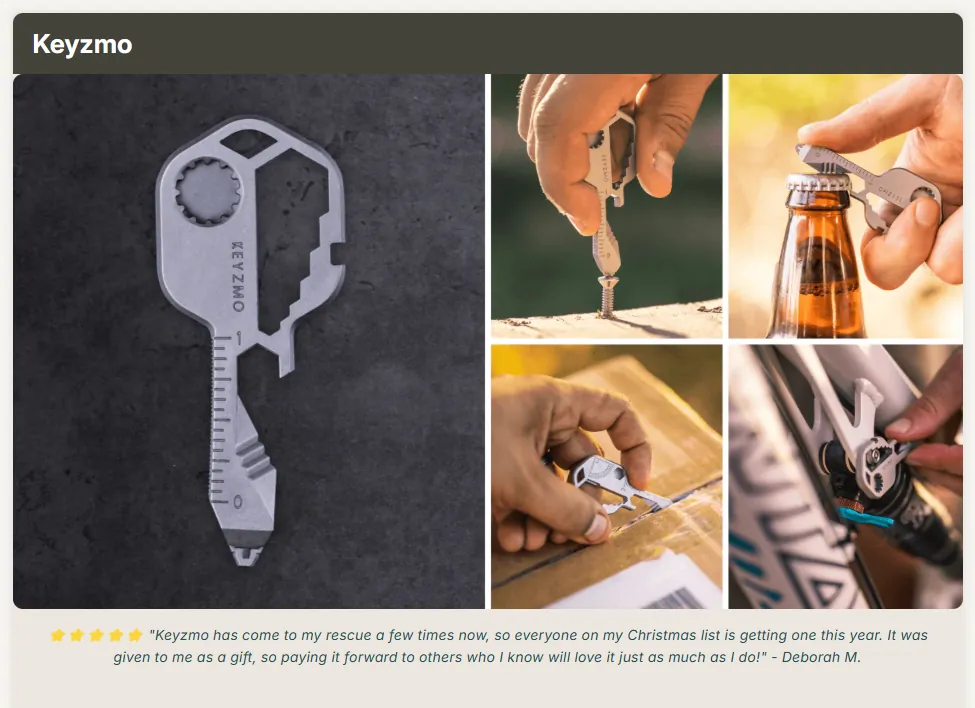
Simply put, a listicle is a “product recommendation list” page. You’ve surely seen articles like “The 10 Best Tech Products to Buy in 2026”, right? That’s the thing.
The page lists a bunch of products, each with a link. Whichever one the user clicks, you earn that product’s commission.

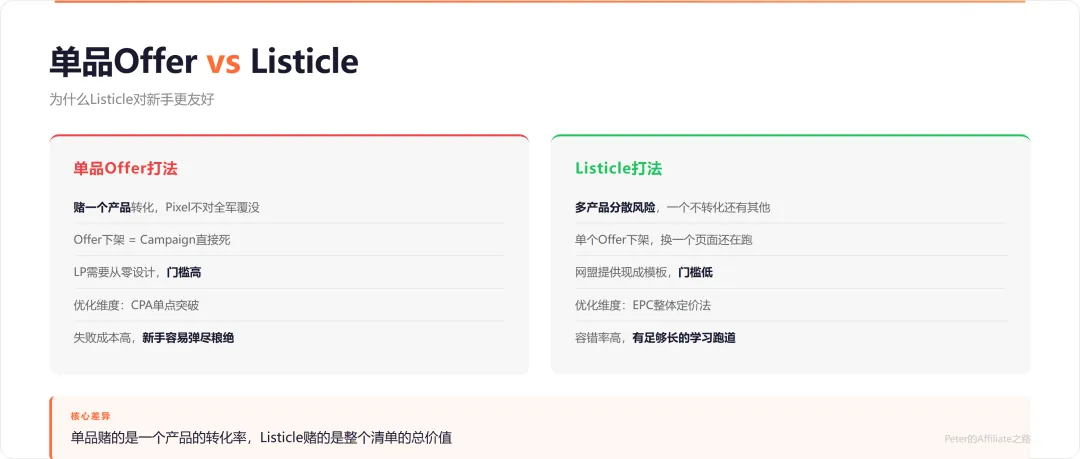
Compared with the traditional single-product offer play, the biggest difference with listicles is this: you don’t depend on one product converting, you depend on the total value of the whole list.
If one product doesn’t convert, no problem; the user may click the third one, or the seventh. One visit can produce multiple clicks, and every click is a chance to convert.
That’s why it’s so well liked: it has a high tolerance for error.
Why 2026 in particular
Three reasons.
First, the budget barrier has dropped
Listicles used to run mainly on Taboola and Outbrain, where the budget barrier easily started at $10k.
But the play has changed: Google Search plus GDN has become the easiest channel to get into, and Meta can keep costs under control with Cost Cap. Native is no longer the only option.
Second, networks are giving better and better support
Networks that specialize in eCom, like DFO and GiddyUp, now provide ready-made listicle templates.
You don’t need to write a landing page from scratch: take the template, fill in the products and you can run. Even if you build it yourself, Anthropic’s newly released Claude Design feature makes it easy to replicate this kind of single page.
And GiddyUp pays separate commission on the extra sales your traffic generates, which most networks don’t do.
Third, the seasonal rhythm is clear
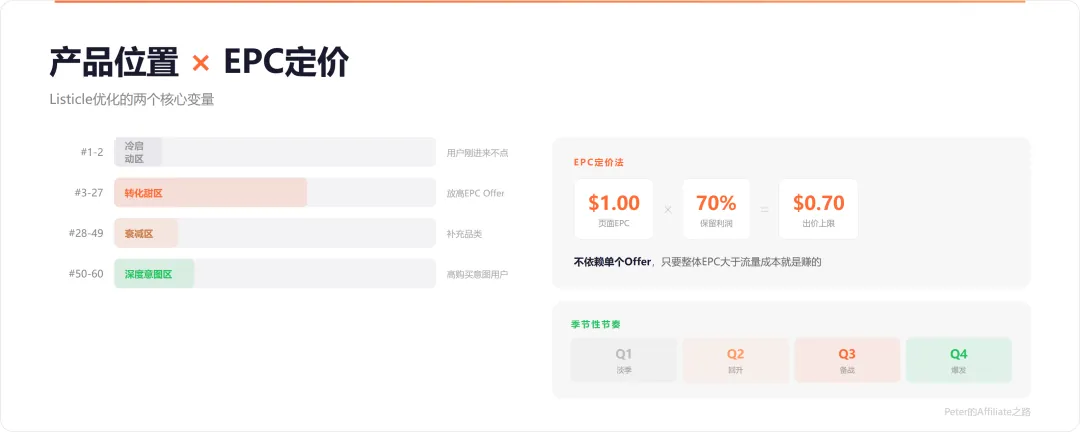
Listicles peak in Q4 every year (October to December, months 10-12), the stretch from Black Friday to Christmas.
So you have most of the year to learn, test and optimize, then go big in Q4. That rhythm is very beginner-friendly; you can do it as a side hustle.

The core logic: EPC-based pricing
Optimizing a listicle is different from a traditional campaign.
The traditional approach looks at CPA; listicles look at EPC (Earnings Per Click).
The logic is simple: what your listicle page earns per visit on average, minus what you paid to buy that visit, is your profit.
For example, if your listicle page has an EPC of $1.00 and you want to keep a 30% margin, your bid ceiling is $0.70.
The advantage of this pricing method is that it doesn’t depend on any single offer’s performance. As long as the page’s average revenue is higher than the traffic cost, you’re making money.
A product got pulled? Swap in another one; the page keeps running.
The science of product placement
In a listicle, where a product sits in the list directly affects conversion.
Straight to the conclusion: don’t put your best offer in first place. Positions #3 to #27 are the conversion sweet spot. Users don’t click the moment they land on the page; they scroll past a few items before they start reading seriously.
There’s another counterintuitive finding: sometimes the offers placed at positions #50-60 get the most conversions, because the users who scroll all the way down have the strongest purchase intent. They’re genuinely picking something.
Product order isn’t something you arrange at random; it’s a variable that needs A/B testing in its own right.
How to choose a traffic channel
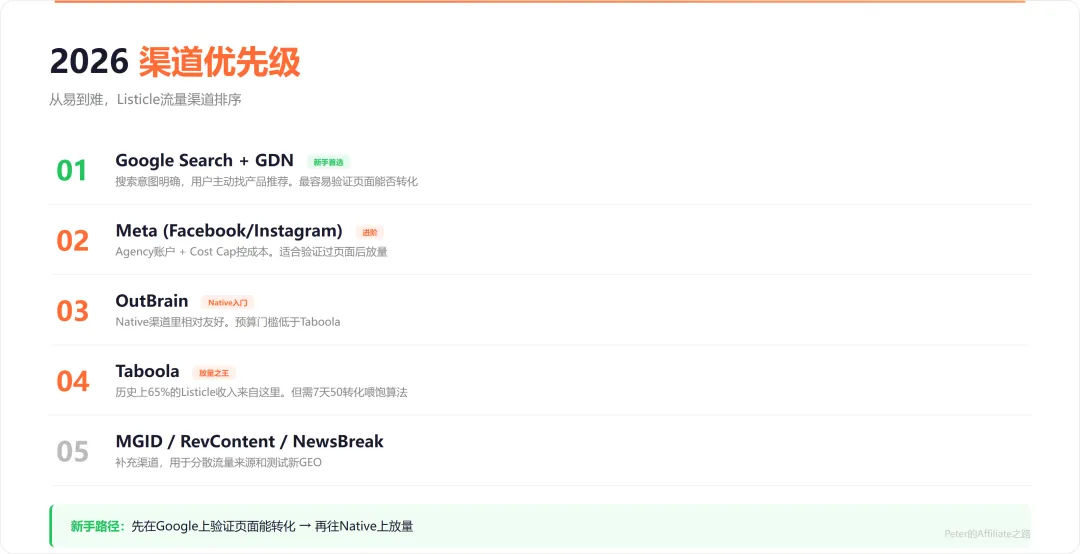
Channel priority for running listicles in 2026:
Google Search plus GDN is the easiest place to start. Search intent is explicit: users are already searching for terms like “best gadgets 2026”, and your listicle is right there to catch them.
Meta is better once you have some experience; with an agency account and Cost Cap you can scale steadily.
Native channels (Taboola, Outbrain) are still the kings of volume, but the budget barrier is high.
Taboola’s algorithm needs to accumulate 50 conversions within 7 days to optimize fully, which means your daily budget can’t be too low. If the offer payout is $50, you may need a daily budget of $500-700 to feed the algorithm.
Advice for beginners: first verify on Google that your listicle page converts, then think about scaling on Native.
One last thing
Honestly, eCom listicles aren’t a windfall play. You won’t make $XXXX a day.
But they have three qualities that beginners need most:
- What you learn is reusable
Once you’ve learned EPC-based pricing, product order testing and the seasonal rhythm of listicles, those skills work in any vertical.
- You won’t lose it all overnight
Multiple products spread the risk, unlike a single-product offer where one wrong pixel wipes out the whole thing.
- It can be done long term
eCom plus Native is an evergreen combination: when an old offer in a niche gets pulled, there’s always a new one coming in to replace it.
A friend who has been playing this for a few years told me: listicles aren’t a get-rich-overnight play, but they’re the legit approach that teaches you this industry properly.
A beginner’s biggest enemy isn’t losing money; it’s wanting to try every direction and not knowing where to start. What listicles give you is a runway long enough to build up confidence and experience along the way.
New articles and quick notes from Peter.