 Peter Founder
What Is the Facebook '$1 Ad Set' Method? AI Is Speeding It Up


Anyone who runs Facebook has been through this scene:
A creative is running fine at a few hundred conversions a day, then suddenly the volume drops, and adding budget doesn’t bring it back. Throwing it away feels like a waste; forcing it loses money.
There’s a play built specifically for this situation, also used to take cheap shots at luck: the $1 ad set method.
Now this play has picked up another layer: AI has stepped in and made it faster to draw the blade.
So today, a piece on the AI-plus version of the $1 ad set method.
1. What is the Facebook $1 ad set method?
Simply put, the $1 ad set method means running a very low budget across a large number of ad sets, using sheer quantity to bump into cheap conversions.
First, let me correct the most common misconception:
A lot of people think it’s ABO with a $1 budget per ad set. It isn’t.
Give an ad set a $1 budget directly under ABO (conversions objective) and the system most likely won’t spend anything that day; it only starts to slowly spend the next day. You’re waiting for nothing.
The correct structure is CBO: give the campaign $100, hang 100 ad sets under it, and set a $1 spend cap on each ad set.
Out of 100 ad sets, there are always a few that bump into a cheap conversion.
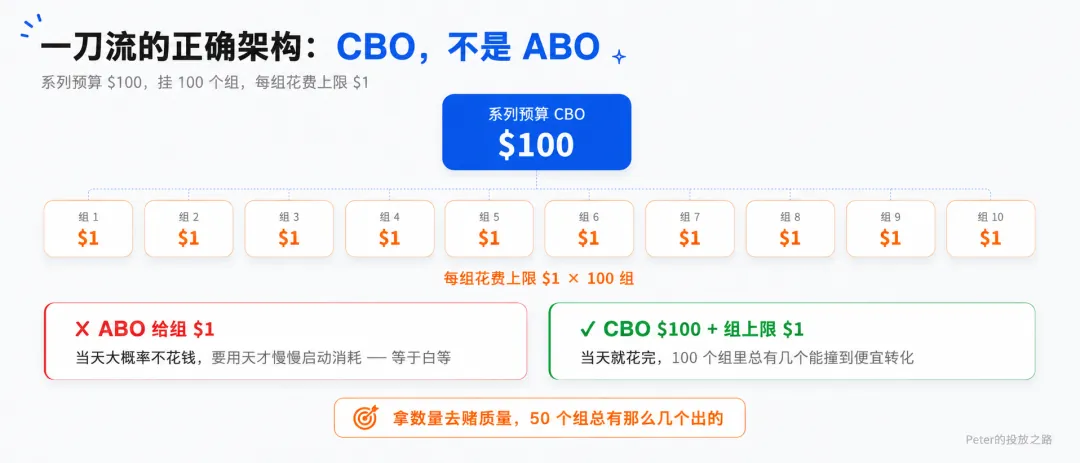
In other words: you’re trading quantity for quality. Out of 50 ad sets, a few will always produce.
——
Its role, though, is more like a salvage tool, because the $1 ad set method isn’t a primary scaling strategy. It’s more of a tool:
Squeezing residual value: once a winning creative loses volume, use the $1 method to squeeze out one more round.
For example: the original post has built up 2,000 likes and 1,000 comments. That social proof on its own makes sales easier.
A product-testing tool: a creative that hasn’t proven itself won’t even spend $1. A pure waste of time.
It has a cost: the $1 method accelerates creative fatigue. Once it’s burned out, it’s really done.
2. The play: how to swing, how to add budget
Running the $1 method usually has three hard prerequisites:
The account has to be aged: don’t even think about it with a new account; surviving normal running is already good going.
Proven creatives: the $1 method generally runs the same creative that has already been validated. Unproven creatives won’t spend.
The offer has to work: a bad offer won’t run no matter what. That’s a hard requirement.
Once those are met, the key move is adding budget. The $1 method isn’t about tossing small budgets at luck and then shutting it off; when an ad set gets going, you have to dare to add:
An ad set has conversions 3 days in a row ↓ budget ×10 ($1→$10), run for 1-3 hours ↓ if it takes off, keep adding; if not, shut it off ↓ if you’ve got the nerve, ×100 again ($1→$100)
My personal experience: one result, put a 1 in front of the budget; two results, add a 0 at the end.
The $1 method isn’t just one dollar, either.
There are also $2, $3, $5 and $10 versions. You can lock the account’s total budget, burn through the whole limit in one go within an hour, then look at the results and decide whether to add.
How many dollars per ad set you go with scales with how boldly you act, how well you judge, and how the results look.
3. What AI added: it draws the blade faster
Since AI came in, the $1 method can now be a production line:
Spy creatives → AI rework and dedup ↓ Agent Skills ↓ AI tool bulk-uploads 100+ ad sets ↓ $1 method runs volume
AI does three things in there:
Creative dedup: rework the spied creatives with AI to make them unique, replacing the creative designer.
Bulk ad upload: manually duplicating dozens of ad sets in the FB front end tends to freeze up; an AI tool uploads 100-plus ad sets in bulk.
Lowering the manpower barrier: this used to need a senior media buyer; now a process plus an agent validation loop is enough to get started.
4. My take
That’s the play. Now a few words of my own opinion.
At its core, the $1 method is a tool for playing the odds, not a standard play.
When it’s good it’s really sweet; when it’s bad it’s painful.
And these creatives are often very aggressive, so the users they bring in may not stick. In the end the product has the final say.
In one sentence: product > creative > technique. The more automated the tools get, the more that layer of judgment is worth.
The $1 method is worth knowing, and AI has made it faster, but don’t treat it as your main play, and definitely don’t let it cost you the fundamentals of regular scaling.
However fast you draw the blade, if it doesn’t land on the right product, it’s all for nothing.
New articles and quick notes from Peter.